Graphical Guide to Cemetery Symbolism

The purported grave of Mother Goose, Granary Burying Ground, Boston, Massachusetts, USA.  Source: Wikipedia user Swampyank.

The purported grave of Mother Goose, Granary Burying Ground, Boston, Massachusetts, USA. Source: Wikipedia user Swampyank.

From Altas Obscura, a guide to the symbolism found in graveyards–apropos for Halloween.

Growing up near Boston, I sometimes wandered the burying grounds in Boston where the stones date back to the founding of Boston.  Many of the colonial era graves have intricate carvings which are still crisp and sharp.  Death, the winged skull, the winged hourglass (Tempus Fugit!) and the draped urn are all symbols of death that can be seen there.

And this was all before the excess decoration of the Victorian Era.

“Bicycle Face” and the Suffrage Movement

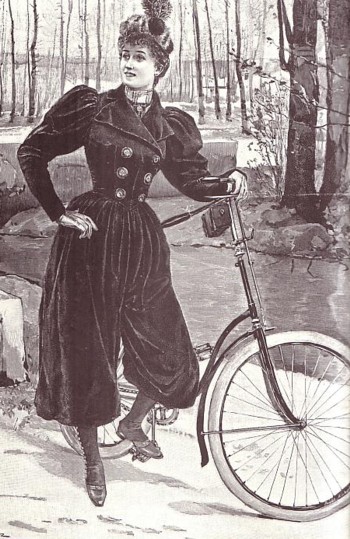
Bicyclist wearing practical bloomers. (Still looks like she's wearing a corset though.)

Bicyclist wearing practical bloomers. (Still looks like she’s wearing a corset though.)

Below is a link to an interesting article about how the Bicycle Craze of the 1890s became interwoven with the women’s suffrage movement.  While high-wheeled “penny farthing” bicycles were ridden mainly by men, the adoption of the safety bicycle in the late 1880s popularized bicycling by women.  Suddenly, the bicycle enabled women to leave the home, and get exercise in the outdoors.  Continue reading

Steampunk Beauty?

CerdaThe portrait above is of Doña Ana de Mendoza, the Princess of Éboli, a 16th century Spanish noblewoman.

Born into the tempestuous house of Mendoza in 1540 (apparently her father was an infamous philanderer), she has been described as passionate, intelligent, religious, and rebellious in her youth.  The story goes that she lost her right eye in an accident while fencing with a page when she was 12 years old.  There is some controversy about the exact nature of her injury and whether it was caused through fencing.  A very in depth biography of Doña Ana and her ophthalmologic details is here (on a fencing club website!).  Despite the eyepatch that she wore the rest of her life, she was known as one of the foremost beauties of the court.

Married off at age 13 to Ruy Gómez de Silva, a courtier 24 years her senior, the marriage was apparently not consummated for several years due to his travels with King Philip II of Spain.  Her husband apparently stayed around after that as she eventually bore 10 children.  Upon her husband’s death in 1573, she entered a convent for a couple of years, apparently not getting along well with the other nuns, which prompted her leaving.

She returned to court and all its intrigues which she promptly became caught up in.  She was widely known to have had a relationship with Antonio Perez, a secretary to Philip II.  Was it a romantic, or merely a political, relationship?  There were rumors of a dalliance with the King himself, accusations of a conspiracy to murder, and claims of betraying state secrets. She was eventually sentenced, and died after spending her last 13 years in prison.

Still, what a model for a steampunk heroine!  Did she really lose her eye in a fencing accident, or was she a time-traveler saving 16th century Spain from airpirates from the future?  Her intelligence and rebellious nature make her the perfect ahead-of-her-time princess battling with her army of warriors crafted with cursed Aztec gold for the right to be equal to the pompous male courtiers who surrounded her, only to be thwarted at the end.

Historical figures like Doña Ana are grist for the mill of imagination!

Thanks to the Two Nerdy History Girls website for posting a link to Doña Ana’s portrait and inspiring my imagination.

The Poetry of Scientists

An interesting insight into a seldom-seen facet of Victorian Scientists. Who knew John Tyndall was a poet?

drgregorytate's avatarGregory Tate

On shelf after shelf of carefully catalogued notebooks and sheets of paper, the archives of the Royal Institution in London store the voluminous manuscript writings of nineteenth-century scientific pioneers such as Humphry Davy and John Tyndall. Among these manuscripts are a surprising number of poems, painstakingly drafted, revised, copied out, and reworked. I’ve been working in the Royal Institution’s archives recently, researching both for my second academic monograph and for a documentary, ‘The Poetry of Science’, which will be broadcast as part of BBC Radio 3’s Sunday Feature on Sunday 2 November. I’ve been trying to figure out why nineteenth-century scientists (Davy, Tyndall, William Whewell, John Herschel, James Clerk Maxwell) were so interested in writing poetry. The copious crossings-out and emendations in the Royal Institution manuscripts indicate that Davy and Tyndall took care and time over their poems, editing and polishing them; poetry wasn’t simply a recreation. But why…

View original post 1,024 more words

The Berners Street Hoax

History tends to lack a sense of humor.  Rarely does one come across a real side-splitting tale amongst the social trends and political machinations that underlie the dates of important treaties and the names of the monarchs that signed them (usually Charles or Frederick, according to my son who studied European History last year).

"The Berners Street Hoax" from The Choice Humorous Works of Theodore Hook

“The Berners Street Hoax” from The Choice Humorous Works of Theodore Hook

In 1810, on November 26th to be exact, one singular event occurred in London which could win the award for funniest historical event (a low bar there…) Continue reading

The Art of Travel

A couple of years ago in a panel I did on Victorian Scientists at Clockwork Alchemy, the San Jose Steampunk con, I talked about Francis Galton. “Who?” you may ask. Francis Galton may be the most talented Victorian Scientist that no one has ever heard about today. The breadth of his work is jaw-droppingly astounding. Born in 1822 into the celebrated Wedgwood-Darwin clan (and half-cousin to Charles Darwin), he had all the advantages of a Victorian gentleman, including a wealthy father who died young leaving him with the means to be a gentleman-scientist for the rest of his life.

Young Francis was a child prodigy, reading by age two and knowing Greek and Latin by his fifth birthday. He was impatient with formal schooling, however, and bounced around aimlessly from school to school. He eventually earned an undistinguished degree from Cambridge, but only after suffering a nervous breakdown. Upon the death of his father, he left his studies and turned to travel, science, and invention.

Francis Galton in the 1850s

Francis Galton in the 1850s

Continue reading

The Colors of the Past

One of the more interesting ways to while away the hours is by looking at old photographs, especially those from the birth of photography in the mid-1800s. An amazing amount of detail  can be gleaned from a photograph printed from a large glass plate.

But are we really seeing what we think we’re seeing? First off, the images are necessarily monochromatic—black and white. Any color that is seen in black-and-white photographs is a result of hand-tinting the photograph, typically to put some color in the subject’s cheeks. Color photography, although experimented with even early on in photography’s history, was extremely cumbersome, and required laboratory-grade equipment to pull off. Even the great Scottish physicist James Clerk Maxwell thought about color reproduction and what is considered to be the first color photograph was made using a technique he first described.

So we’re left with black-and-white photography for the Victorian Era. But are we really seeing a proper monochromatic reproduction of reality? In most cases, the answer is no. Continue reading