Fall First Page Critique Blog Hop

I learned about this from Miss Alexandrina’s blog, and thought it an interesting and useful idea.  We offer up a first page for critique and in exchange, critique the five works above and below ours on the list in return.

So here’s mine:  It’s the first 250 words or so from my present NaNoWriMo work-in-progress, which has a working title of “The Secret Notebook of Michael Faraday”, a prequel to my recently published steampunk adventure novel.

It was unlike anything the boy had ever seen.

He had seen large buildings before, of course. Being from the City, he had grown up in the shadow of the great dome of St. Paul’s, and had even ventured inside once at the end of a morning service when the vergers would not notice a poorly dressed boy. The tall spaces of the great cathedral amazed him, but that building was made of stone, and sat squarely upon the ground. This building was made almost entirely of glass and seemed to soar.

“Come along, Nicodemus,” said Mr. Dalrymple, the boy’s master. “Let’s not dawdle. We have lots to see today.”

The boy, staring slack-jawed and wide-eyed at the wonders before him, could only manage, “Cor…”.

“Nicodemus!”

“Yes, sir,” said young Nicodemus, and followed along behind the man.

The Great Exhibition of the Works of Industry of all Nations was the wonder of London all through the summer of 1851. Since being officially opened by Her Majesty the Queen in May, almost 5 million people had visited and been marveled by its exhibits. Housing the Exhibition was, of course, the Crystal Palace, a enormous building almost a third of a mile long and over 120 feet high.

Nicodemus and his master stopped under the great dome at the center of the building. The space stretched as far as Nicodemus could see in either direction. “What’ll we see first, Mr. Dalrymple? It’s so big!” exclaimed Nicodemus, still straining his neck to look around at everything at once.
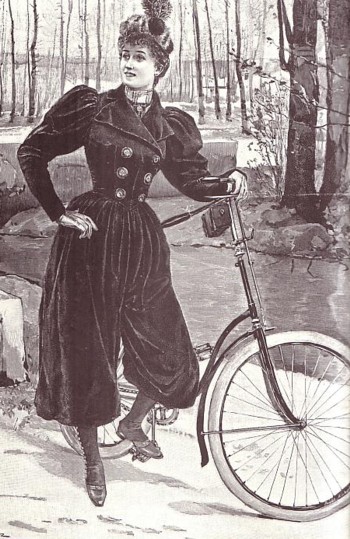
“Bicycle Face” and the Suffrage Movement

Bicyclist wearing practical bloomers. (Still looks like she's wearing a corset though.)

Bicyclist wearing practical bloomers. (Still looks like she’s wearing a corset though.)

Below is a link to an interesting article about how the Bicycle Craze of the 1890s became interwoven with the women’s suffrage movement.  While high-wheeled “penny farthing” bicycles were ridden mainly by men, the adoption of the safety bicycle in the late 1880s popularized bicycling by women.  Suddenly, the bicycle enabled women to leave the home, and get exercise in the outdoors.  Continue reading

Steampunk Beauty?

CerdaThe portrait above is of Doña Ana de Mendoza, the Princess of Éboli, a 16th century Spanish noblewoman.

Born into the tempestuous house of Mendoza in 1540 (apparently her father was an infamous philanderer), she has been described as passionate, intelligent, religious, and rebellious in her youth.  The story goes that she lost her right eye in an accident while fencing with a page when she was 12 years old.  There is some controversy about the exact nature of her injury and whether it was caused through fencing.  A very in depth biography of Doña Ana and her ophthalmologic details is here (on a fencing club website!).  Despite the eyepatch that she wore the rest of her life, she was known as one of the foremost beauties of the court.

Married off at age 13 to Ruy Gómez de Silva, a courtier 24 years her senior, the marriage was apparently not consummated for several years due to his travels with King Philip II of Spain.  Her husband apparently stayed around after that as she eventually bore 10 children.  Upon her husband’s death in 1573, she entered a convent for a couple of years, apparently not getting along well with the other nuns, which prompted her leaving.

She returned to court and all its intrigues which she promptly became caught up in.  She was widely known to have had a relationship with Antonio Perez, a secretary to Philip II.  Was it a romantic, or merely a political, relationship?  There were rumors of a dalliance with the King himself, accusations of a conspiracy to murder, and claims of betraying state secrets. She was eventually sentenced, and died after spending her last 13 years in prison.

Still, what a model for a steampunk heroine!  Did she really lose her eye in a fencing accident, or was she a time-traveler saving 16th century Spain from airpirates from the future?  Her intelligence and rebellious nature make her the perfect ahead-of-her-time princess battling with her army of warriors crafted with cursed Aztec gold for the right to be equal to the pompous male courtiers who surrounded her, only to be thwarted at the end.

Historical figures like Doña Ana are grist for the mill of imagination!

Thanks to the Two Nerdy History Girls website for posting a link to Doña Ana’s portrait and inspiring my imagination.

NaNoWriMo and the Accidental Novelist

I have participated in NaNoWriMo for the past two years, and will again this year, but more on that later.

To those unacquainted, NaNoWriMo, or National Novel Writing Month, is an event that takes place every November in which participants are encouraged to write 50,000 words of a novel. The philosophy is to just get the words down on paper (or computer screen). Don’t worry about editing; don’t worry about research. Sit your butt in your chair and pour out 50,000 words over the thirty days of November. We’ll deal with editing later. Continue reading

The Art of Travel

A couple of years ago in a panel I did on Victorian Scientists at Clockwork Alchemy, the San Jose Steampunk con, I talked about Francis Galton. “Who?” you may ask. Francis Galton may be the most talented Victorian Scientist that no one has ever heard about today. The breadth of his work is jaw-droppingly astounding. Born in 1822 into the celebrated Wedgwood-Darwin clan (and half-cousin to Charles Darwin), he had all the advantages of a Victorian gentleman, including a wealthy father who died young leaving him with the means to be a gentleman-scientist for the rest of his life.

Young Francis was a child prodigy, reading by age two and knowing Greek and Latin by his fifth birthday. He was impatient with formal schooling, however, and bounced around aimlessly from school to school. He eventually earned an undistinguished degree from Cambridge, but only after suffering a nervous breakdown. Upon the death of his father, he left his studies and turned to travel, science, and invention.

Francis Galton in the 1850s

Francis Galton in the 1850s

Continue reading

How to Build a World, (or at least how to keep track of it)

A reader entering the world you created.  (Source:Camille Flammarion's L'atmosphère: météorologie populaire (1888).)

A reader entering the world you created. (Source: Camille Flammarion’s L’atmosphère: météorologie populaire (1888).)

Many articles and blogs have been written on Worldbuilding by writers far more experienced than I, such as here and here. Still, some lessons that I have learned may be helpful.

When I began writing my first steampunk novel To Rule the Skies, I had no idea that I was starting in the middle of Professor Nicodemus Boffin’s saga, but at some point I realized that Boffin’s back story would make a fine story in itself. Now that I’m deep into writing another book (the aforementioned prequel), I think a lot about the world I’ve created for my characters to live in (which I call the “Boffin-verse”), and spend a lot of time making sure that it’s all consistent. Continue reading

Quick DIY Plastic Steampunk Pistol Mod

Yikes!  Halloween is less than three weeks away and I haven’t even started on my steampunk costume yet.

If this is you, fear not.  It’s not impossible to make a passable steampunk pistol prop in only a couple of days.  A few years ago, my son wanted to dress steampunk for Maker Faire.  We put together a reasonable outfit (He already owned goggles…), but he wanted a pistol to top it off, and Maker Faire was only a few days away.

Fortunately, I had found this water pistol recently at a dollar store.

Water pistol before...

Water pistol before…

I know.  I’m sorry–the colors are not so tear-inducing in real life, but close. I will show you how to change this garish monstrosity into a steampunk pistol.  If you look past the eye-throbbing colors, you can see that this pistol actually has pretty good details molded into it–a water tank (the large red bit), fins, a smaller tank, tubing, rivets, etc.  So, I lucked out and found one that was easily adaptable to begin with. If you’ve got the time, look around at dollar stores, thrift shops, flea markets, second-rate toy stores, etc., for a pistol you can imagine as steampunk–with a little work.  If not, just about anything can be  made to look steampunk–or at least, more steampunk–with judicious application of paint. Continue reading