The Poetry of Scientists

An interesting insight into a seldom-seen facet of Victorian Scientists. Who knew John Tyndall was a poet?

drgregorytate's avatarGregory Tate

On shelf after shelf of carefully catalogued notebooks and sheets of paper, the archives of the Royal Institution in London store the voluminous manuscript writings of nineteenth-century scientific pioneers such as Humphry Davy and John Tyndall. Among these manuscripts are a surprising number of poems, painstakingly drafted, revised, copied out, and reworked. I’ve been working in the Royal Institution’s archives recently, researching both for my second academic monograph and for a documentary, ‘The Poetry of Science’, which will be broadcast as part of BBC Radio 3’s Sunday Feature on Sunday 2 November. I’ve been trying to figure out why nineteenth-century scientists (Davy, Tyndall, William Whewell, John Herschel, James Clerk Maxwell) were so interested in writing poetry. The copious crossings-out and emendations in the Royal Institution manuscripts indicate that Davy and Tyndall took care and time over their poems, editing and polishing them; poetry wasn’t simply a recreation. But why…

View original post 1,024 more words

The Art of Travel

A couple of years ago in a panel I did on Victorian Scientists at Clockwork Alchemy, the San Jose Steampunk con, I talked about Francis Galton. “Who?” you may ask. Francis Galton may be the most talented Victorian Scientist that no one has ever heard about today. The breadth of his work is jaw-droppingly astounding. Born in 1822 into the celebrated Wedgwood-Darwin clan (and half-cousin to Charles Darwin), he had all the advantages of a Victorian gentleman, including a wealthy father who died young leaving him with the means to be a gentleman-scientist for the rest of his life.

Young Francis was a child prodigy, reading by age two and knowing Greek and Latin by his fifth birthday. He was impatient with formal schooling, however, and bounced around aimlessly from school to school. He eventually earned an undistinguished degree from Cambridge, but only after suffering a nervous breakdown. Upon the death of his father, he left his studies and turned to travel, science, and invention.

Francis Galton in the 1850s

Francis Galton in the 1850s

Continue reading

The Colors of the Past

One of the more interesting ways to while away the hours is by looking at old photographs, especially those from the birth of photography in the mid-1800s. An amazing amount of detail  can be gleaned from a photograph printed from a large glass plate.

But are we really seeing what we think we’re seeing? First off, the images are necessarily monochromatic—black and white. Any color that is seen in black-and-white photographs is a result of hand-tinting the photograph, typically to put some color in the subject’s cheeks. Color photography, although experimented with even early on in photography’s history, was extremely cumbersome, and required laboratory-grade equipment to pull off. Even the great Scottish physicist James Clerk Maxwell thought about color reproduction and what is considered to be the first color photograph was made using a technique he first described.

So we’re left with black-and-white photography for the Victorian Era. But are we really seeing a proper monochromatic reproduction of reality? In most cases, the answer is no. Continue reading

CSI: Victorian London

Take one part Dr. Gregory House, add a bit of Sherlock Holmes and a pinch of modern forensic science, and you have Dr. John Snow, a man who solved one of the largest mass killings in Victorian London.

The culprit: cholera. Ever since it first appeared in Britain in 1831, cholera periodically ravaged the cities, leaving thousands dead in its wake. In 1848-9, over 14,000 Londoners died; in 1853-4, another 10,000 succumbed. That the disease was somehow related to the deplorable conditions of British cities at the time was clear, but the means of transmission was believed by all authoritative men of medicine to be via “miasma”. Miasma was thought to be a sort of poisonous vapor or mist originating from decomposing matter, called miasmata. (Similarly, the word “malaria” comes from the Italian meaning “bad air”.) To prevent outbreaks, it was thought to be a simple matter of removing the miasmata. That many of London’s cholera outbreaks occurred along the banks of the Thames, the stinking fetid pool that was the depository of much of the capital’s sewage, only served as proof of the theory’s validity. Continue reading

Luminosity and Electricity in the Sky

An article by Phil Plait, the “Bad Astronomer” on Slate.com reminded me that today (September 1) is the 155th anniversary of the observation of the solar flare that within a day would cause the Great Auroral Storm of 1859.

This interesting astronomical event is of special interest to me as it is recounted in my upcoming novel “To Rule the Skies”.

Richard Carrington, an English gentleman-scientist and amateur astronomer, was sketching sunspots at the observatory he built at his estate at Redhill, Surrey, part of a survey of sunspots that went back almost a decade. He noted two bright flares emanating from one particular group of sunspots.  As he watched, the flares moved across the surface of the spot, then disappeared.

Carrington's sketch of the sunspot observed on Sept 1., 1859.  Solar flares observed at points A & C moved to points B & D in 5 minutes.

Carrington’s sketch of the sunspot observed on Sept 1., 1859. Solar flares observed at points A & C moved to points B & D in 5 minutes.

It was later noted that Carrington’s observation coincided with a deviation in the Earth’s magnetic field measured at Kew Observatory. But more importantly, in the next few days, all hell broke loose in the sky. Continue reading

Beautiful Scientific Illustrations on Retronaut

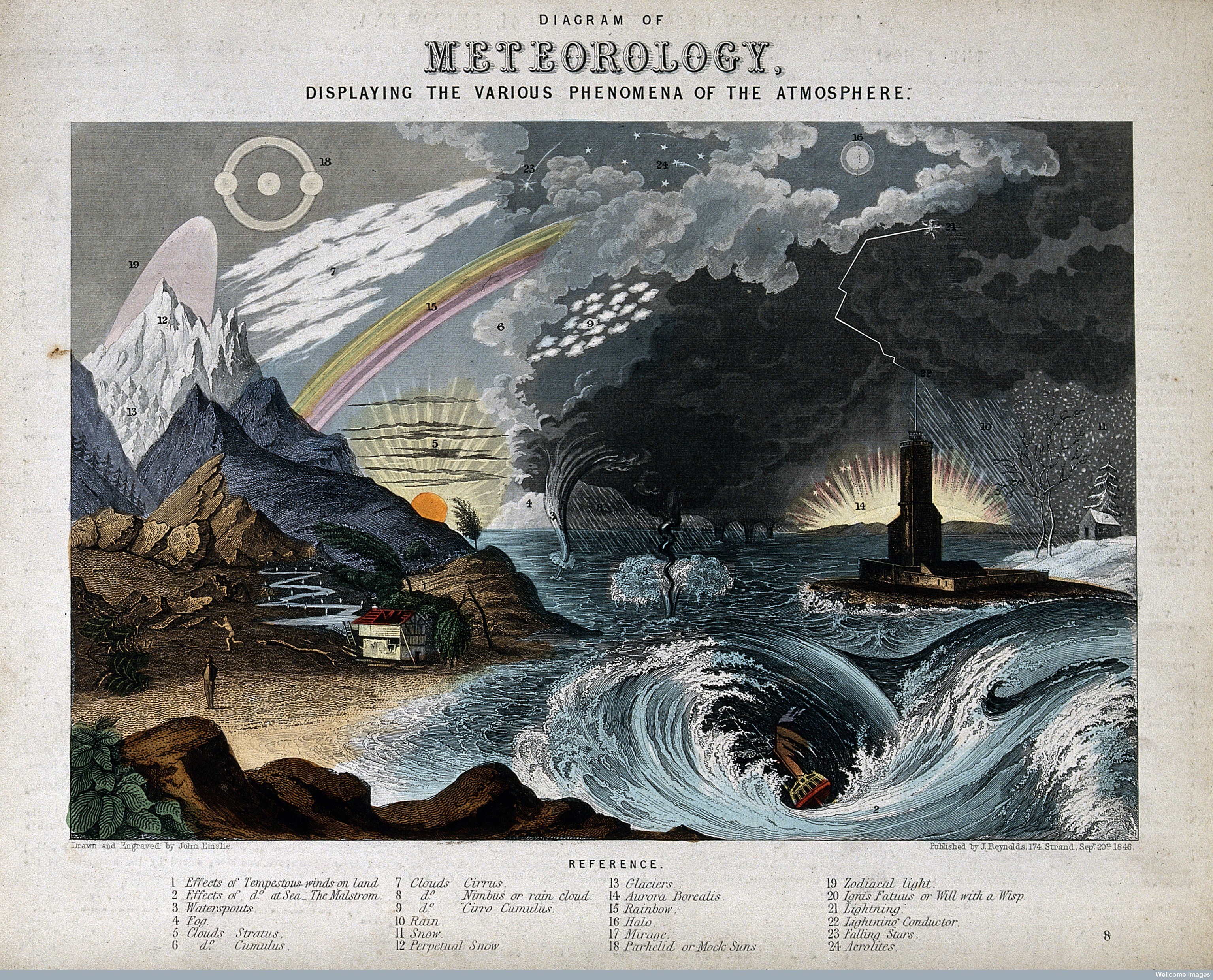
V0025020 Astronomy: a diagram of various atmospheric effects. Coloure

If you’re not familiar with the website Retronaut  (and you really should be), it’s a collection of all manner of vintage photographs and illustrations spanning millenia. One can easily spend vast amounts of time perusing this site!

The site recently featured a number of beautiful colored engravings on scientific topics by John Philipps Emslie, a Victorian age illustrator.  I find his work beautiful and strangely modern in the methods he uses to impart information. Reproduced above is his Diagram of Meteorology.  Retronaut has a couple of collections of his work.

Infographics of the Natural World

Scientific Diagrams

Enjoy!