Starry Starry Night

One stereotypical character of the Victorian Age is the “gentleman scientist”, men (and they were, with the exception of Lady Ada Lovelace, all men) with the financial wherewithal to putter around in their scientific pursuits without the need to actually work for a living.  Charles Darwin, Humphrey Davy, and Benjamin Franklin were all men of independent means and scientific interests.

Another was William Parsons.  Although less famous than the examples above, William Parsons was fortunate enough to inherit an earldom and a large estate in Ireland upon his father’s death. Now as the 3rd Earl of Rosse, he was free to concentrate on his astronomical pursuits.

Although Ireland may seem to have disadvantages as the site of an astronomical observatory—cloudy skies, moisture, and an elevation close to sea level come to mind—he had plenty of land there and plenty of money. So Lord Rosse started building increasingly larger telescopes at Birr Castle culminating in 1845 in a massive instrument with a 72-inch diameter mirror dubbed “The Leviathan of Parsonstown”. It was unlike any previous telescope, requiring massive machinery to move.  It wasn’t until 1918 when the 100-inch Mount Wilson telescope in California was built that a larger telescope was achieved.

The Leviathan of Parsonstown

Lord Rosse’s special interest was solving the nebula problem. Nebulae were faint fuzzy objects in the sky. One group of astronomers believed that they were gas clouds, while the opposition thought them clusters of stars which only appeared fuzzy when observed through telescopes of insufficient size.

And there was no telescope of more sufficient size than the Leviathan.  Observations were made.  Some nebulae were resolved into clusters of stars by the Leviathan’s colossal eye.  Others remained stubbornly fuzzy.  The issue was not resolved. (In fact, those objects in the sky called nebulae are two different things:  gas clouds, and galaxies filled with stars, but that wasn’t determined until even larger telescopes with cameras attached were developed.

And that last point is important.  When the Leviathan was built, photography was in its infancy, and astronomical photography even more so. Observations were recorded by making hand-drawn sketches. One of Lord Rosse’s most famous sketches was of the nebula numbered M-51 which he made in 1845. Lord Rosse drew a nebula with spiral arms and a second smaller nebula interacting with it.  The sketch was so much clearer than what had ever been seen before that it was widely reproduced and published in many popular astronomy books of the day throughout Europe.

Drawing by Lord Rosse of nebula M-51 (now called the Whirlpool Galaxy) through the 72-in Leviathan telescope.
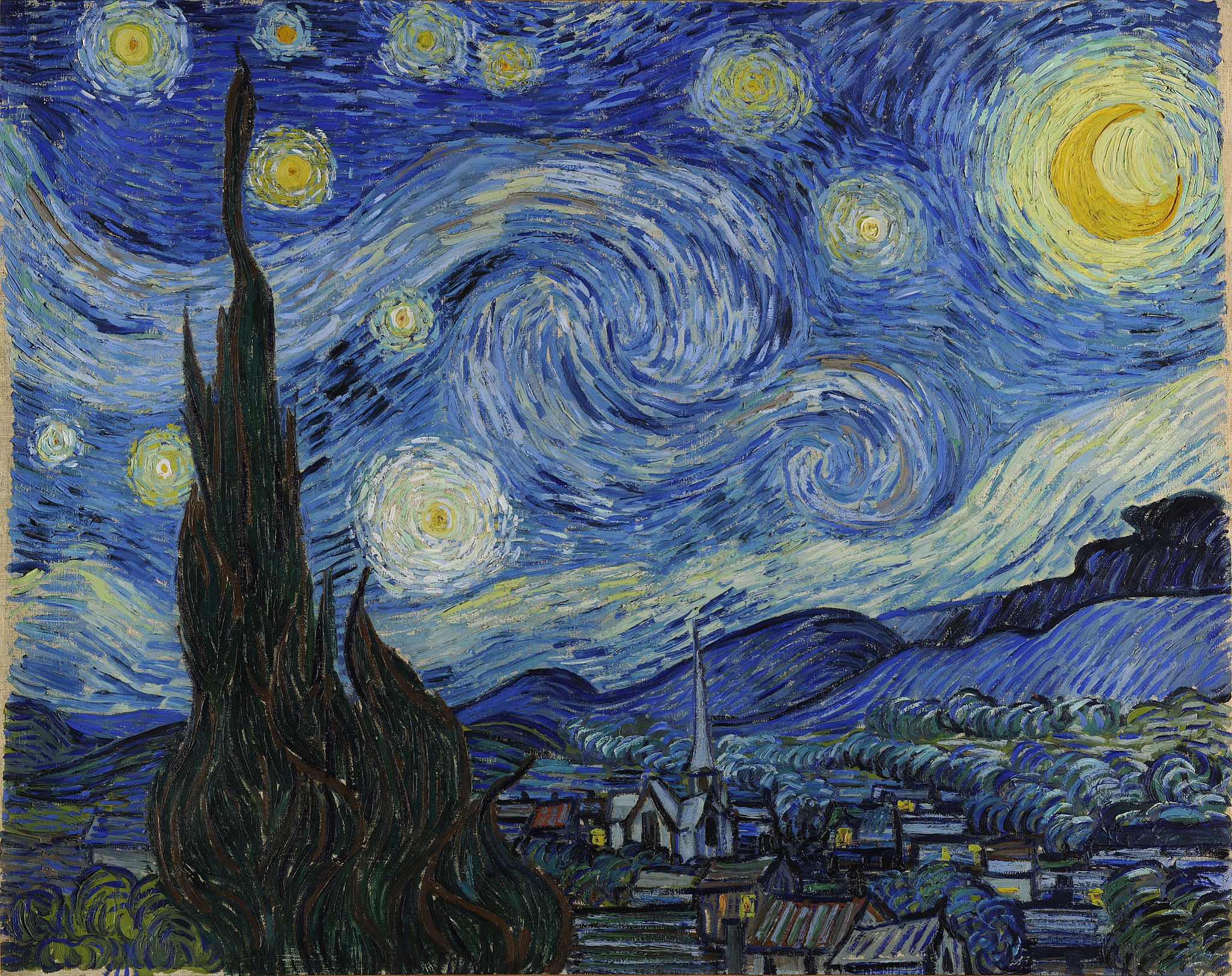
The Starry Night, by Vincent van Gogh, 1889

It does not take much imagination to recognize that Lord Rosse’s sketch of what we now know as the Whirlpool Galaxy greatly resembles the stellar swirls and eddies of Vincent van Gogh’s immortal painting “Starry Night”  Do we know for certain that van Gogh had seen Lord Ross’s sketch? No. Perhaps he did. Or perhaps his artistic vision could tap into the scientific discoveries being made during that time. The two men weren’t contemporaries—“Starry Night” was painted in 1889, forty-four years after Lord Rosse’s sketch—but the sketch was well known.

Perhaps, Lord Rosse and van Gogh approached the same subject from two different vantage points—science and art.  While “Starry Night” is now fixed for all time, progress on astronomical instruments and the observations they are able to make have continued.  Below is a photograph of the Whirlpool Galaxy taken by the Hubble Telescope.  While the abstract billows and curls of Lord Rosse’s sketch appear to us different than they did in 1845, the majesty of the this immense galaxy still provokes awe, just as van Gogh’s does.

M-51, the Whirlpool Galaxy, taken by the Hubble Space Telescope

Scientific Steampunk

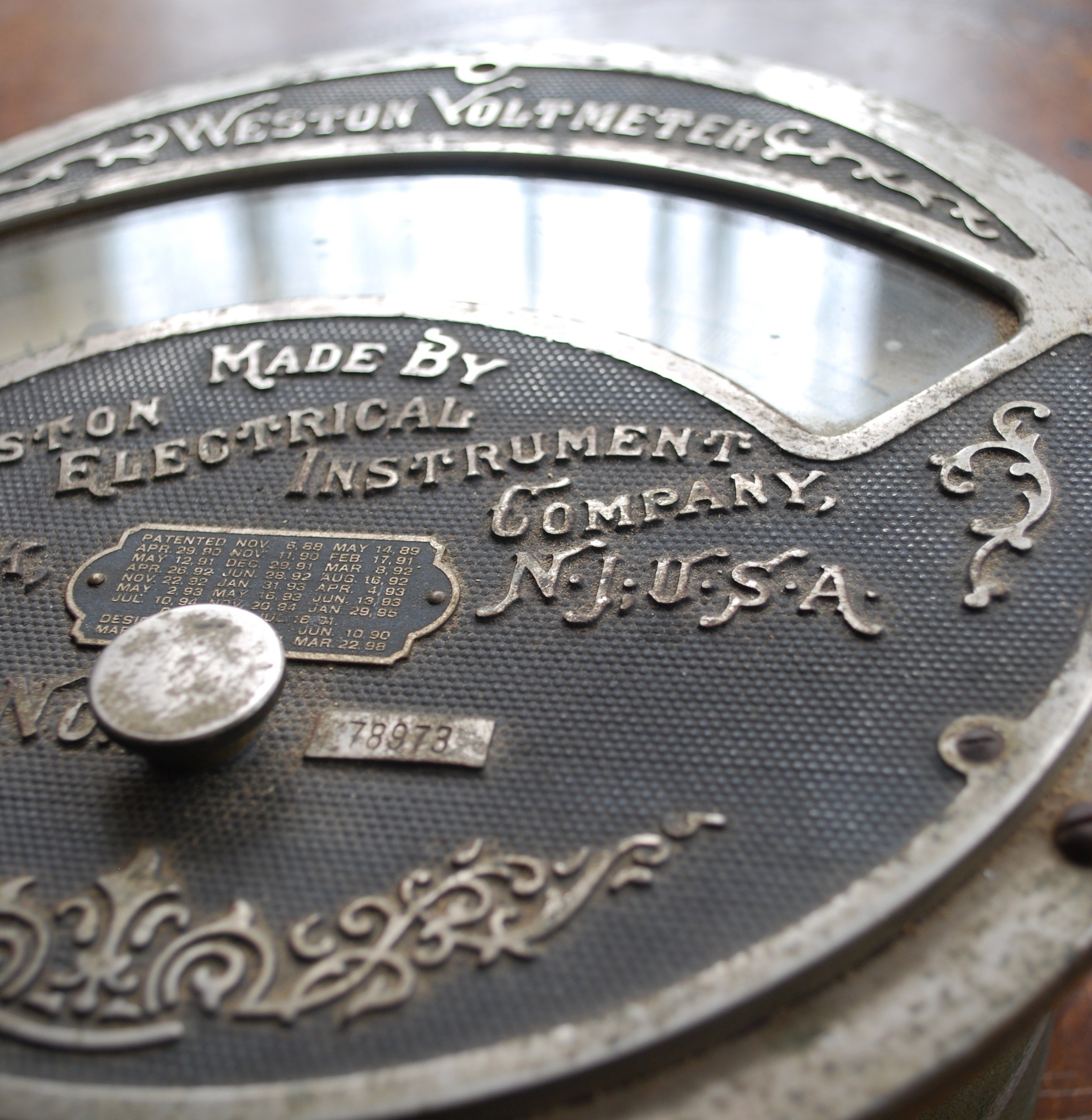
Weston Voltmeter, ca. 1901

Of all the items I own, none embodies the Steampunk Aesthetic more than a Weston Voltmeter that I bought on ebay several years ago.

Take a look at it. Compared with later analog meters, it’s massive The voltmeter measures 10 inches in diameter and weighs about 12 pounds. The face of the device is painted black with what appear to be nickel-plated text and decoration. The earliest patent number on the central plaque is July 16, 1901, meaning that it was built no earlier than that. Its maker, the Weston Electrical Instrument Company, was well-known at the time for the high quality of its electrical measuring devices. Indeed the device seems to accurately measure electrical voltage still.

It is in the same condition as when I bought it. I’ve considered trying to clean it up a bit, but I kind of like the used appearance.

This device evokes the Steampunk Aesthetic by combining both its functionality with its completely unneeded decoration. The filigree and fancy script on its face contribute not a bit to the device’s ability to measure voltage. Yet they are as intrinsic to the device as its function.

Voltmeter detail 1
Voltmeter detail 2

An interesting factoid: Edward Weston, the American chemist, who started the company making, amongst other instrumentation, the Weston Cell, a very precise electrochemical cell (i.e, battery), which was recognized as the international voltage standard until 1990. He named his son Edward Faraday Weston, obviously after the great British chemist, Michael Faraday. And there’s no scientist more steampunk than Faraday!

Charles Darwin Considers Dragons

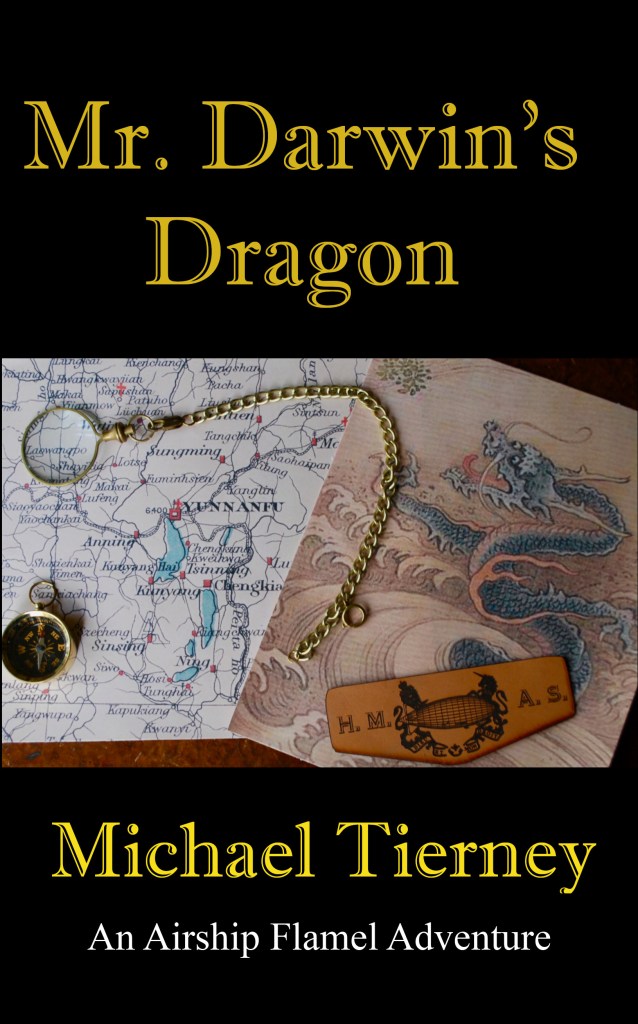
I am happy to offer the electronic version of my latest book, Mr. Darwin’s Dragon, at 50% off ($1.75) during Smashwords‘ July Summer/Winter promotion until the end of July.

This book is the latest Airship Flamel Adventure featuring Professor Nicodemus Flamel, the main character in this series.

Charles Darwin, one of Britain’s most famous and certainly most controversial scientists has a puzzle. How could it be that cultures all over the world–who had no prior contact with each other–have ancient myths of dragons? Could dragons have once lived alongside ancient man? Could dragons still exist?

Professor Nicodemus Boffin and his newly launched airship Flamel takes up the famous naturalist’s request to search for evidence of modern dragons. The voyage takes Flamel from Britain through the Middle East and over the Himalayas to China. The search is barely begun when Flamel discovers an illicit gold mine run by Cai Yuan, a cruel Chinese warlord, and his corrupt British collaborator. Professor Boffin and his family are taken hostage in the mine which seems to be guarded by a fierce dragon. The crew of Flamel must rescue them, and together discover whether Mr. Darwin’s dragon truly exists.

Enjoy!

Happy Birthday, Michael Faraday

Today, Sept. 22, is the great British scientist Michael Faraday’s 226th birthday.

Faraday’s contribution to science are many, and it’s not too much of an exaggeration to say that before Faraday, electricity was batteries, and afterward, it was Edison and Tesla and all the motors, transformers, and generators they unleashed upon the world.

Faraday’s relationship to science can be summed up in two images:  First, Faraday at work at the lab bench in the basement of the Royal Institution, and second, Faraday presiding over a Christmas Lecture–specifically designed for the layman, and for children in particular.

M_Faraday_Lab_H_Moore


Faraday_Michael_Christmas_lecture

Professionally, I work in a field that is the direct descendant of Faraday–electrochemistry–so Faraday has always been a bit of a hero for me.  For more information of Faraday’s life and contributions, see here.  I’ve even written Professor Faraday into one of my novels as a major character, “The Secret Notebook of Michael Faraday“.

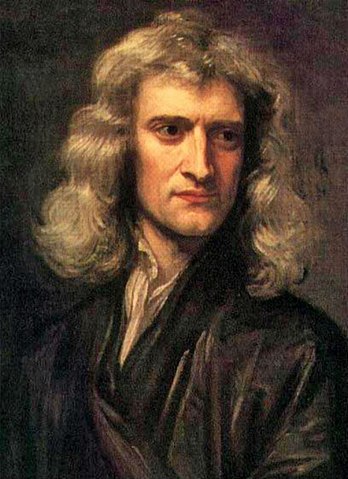
Isaac Newton–Alchemist

348px-GodfreyKneller-IsaacNewton-1689

Isaac Newton, at age 46, portrait by Godfre Kneller, 1689.

Isaac Newton is one of the towering intellects in the history of Science.  He formulated the laws of motion, investigated the nature of light, and invented calculus, among many other accomplishments.  Less well known, however, are his experiments in chymistry. Continue reading

Happy Birthday Michael Faraday!

September 22, 1791 is the birthday of my favorite scientist, Michael Faraday.

Here is a portrait painted of him at age 51, looking much younger than he does in most of his later photographic portraits.

M_Faraday_Th_Phillips_oil_1842

Portrait of Michael Faraday in 1841, painted by Thomas Phillips.

If you’re interested in reading more about this fascinating man, see this blog post.  A slightly more fictional Michael Faraday also features prominently in my latest steampunk adventure novel, “The Secret Notebook of Michael Faraday.”

Mr. Bazalgette and the Fatberg

Of late the dispatches from London have concerned a gigantic “fatberg” that has completely blocked one of the main sewer channels under Whitechapel.  That the capital’s Victorian sewer system is just now reaching capacity is due to the foresight and engineering genius of Mr. Joseph Bazalgette who was given the mandate to update London’s sewer system following a series of cholera epidemics in the 1830s and 1840s.

When calculating out the dimensions of the pipes, he considered the highest population density producing the most amount of sewage.  Then he reportedly said, “Well, we’re only going to do this once and there’s always the unforeseen,” and doubled the diameter.  It is estimated that Bazalgette’s prudence bought an extra 50 years of life to his brick-lined sewage channels, so that only now is London needing to upgrade its system.

A very informative article in Prospect Magazine investigates the genesis of the Fatberg in more detail.