Tips for Makers: Taming Metal Part 2, “Treat and Heat”

Follow-up to the previous post with more information on soldering.

Phoebe Darqueling's avatarFor Whom the Gear Turns

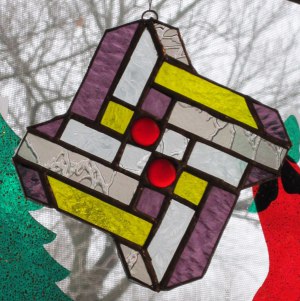
One of my very first sun-catchers. My favorite of the sun-catchers that I have made

Last time I covered some of the kinder, gentler ways to work with metal. In this post, I want to tell you about soldering. This is the metallurgical technique with which I have the most personal experience. I have used it to create silver jewelry and to attach transistors to electrical components like circuit boards, as well as making stained glass sun-catchers and sculptures.

Soldering

    • Solder, a metal alloy used to join other metals together, comes in different varieties that have different melting temperatures, and your solder must always have a melting temperature lower than that of what you are joining.
        • There is soft solder (melting between 190 to 840 °F) and hard solder (840 °F and above), which is sometimes called ‘silver solder‘. When working with high-temperature solder it is often referred to as ‘brazing.’ When a joint is particularly delicate (ie, joining two…

        View original post 502 more words
        Tips for Makers: Taming Metal Part 1, “Glues and Screws”

        An informative and well-written introduction to working with metal for beginning makers.

        Phoebe Darqueling's avatarFor Whom the Gear Turns

        Friends, makers, cosplayers, lend me your ears! (Or eyes as the case would be) I attended several different sessions during my awesome convention experience in Lincoln, including three that were all about making the cool props, costumes, widgets and gadgets that can add that extra zing to your Steampunkery. This is the first installment of a multi-part tipfest for those of you who like to get your hands dirty just in time for Halloween.

        I have taken many art classes in my time, and I was a fine arts major in college before I injured my drawing hand too badly to continue. I still minored in Art History though, and to qualify I took one of my favorite classes of all time, Intro to Sculpture. We worked with a variety of materials over the summer, but my absolute favorite was metal. I love it for two reasons: under the right…

        View original post 624 more words

        Did Mark Twain and Charles Dickens Ever Meet?

        Mark Twain and Charles Dickens were arguably the greatest writers of the 19th century in America and Britain, respectively, and were certainly the most popular. Their careers follow a sort of parallel route as both used their stories to highlight the plight of the downtrodden, and both used the skewer of humor to deflate puffed-up authority figures. A question came up in a writer’s panel I once attended pondering whether they ever met. It turns out I’ve done a little bit of research into that very question.

        I’m fascinated in instances of famous historical personages meeting, and the stories behind them. The famous photo of Nixon posing with Elvis in the Oval Office always comes to mind, although there are many other famous meet-ups in history. Continue reading

        Old House Idiosyncrasies #1–Lighting

        This post is the first in what will be an occasional series on the idiosyncrasies of old houses, their parts, and their décor. Anyone who lives in an old house knows there are many.

        Today, let’s talk about chandeliers. But wait, “chandeliers”, strictly speaking, are lit with candles, even though in today’s vernacular, the term is used for any hanging light fixture. But the Victorians, being ever so precise, invented other terms.

        A “gasolier” was lit with gas. Gasoliers can be identified as the shade points upward, and is usually wider to accommodate the gas jet. The light, such as it was, was produced by a rather dim, flickering open flame. Here’s a catalogue from the period which shows several gasoliers. Another way to identify a gasolier is the presence of a valve usually on the supporting arm, but sometimes on the burner. Continue reading

        The Colors of the Past

        One of the more interesting ways to while away the hours is by looking at old photographs, especially those from the birth of photography in the mid-1800s. An amazing amount of detail  can be gleaned from a photograph printed from a large glass plate.

        But are we really seeing what we think we’re seeing? First off, the images are necessarily monochromatic—black and white. Any color that is seen in black-and-white photographs is a result of hand-tinting the photograph, typically to put some color in the subject’s cheeks. Color photography, although experimented with even early on in photography’s history, was extremely cumbersome, and required laboratory-grade equipment to pull off. Even the great Scottish physicist James Clerk Maxwell thought about color reproduction and what is considered to be the first color photograph was made using a technique he first described.

        So we’re left with black-and-white photography for the Victorian Era. But are we really seeing a proper monochromatic reproduction of reality? In most cases, the answer is no. Continue reading

        Eerie Animated GIFs

        tumblr_nbpb85vvRv1qlq9poo3_500

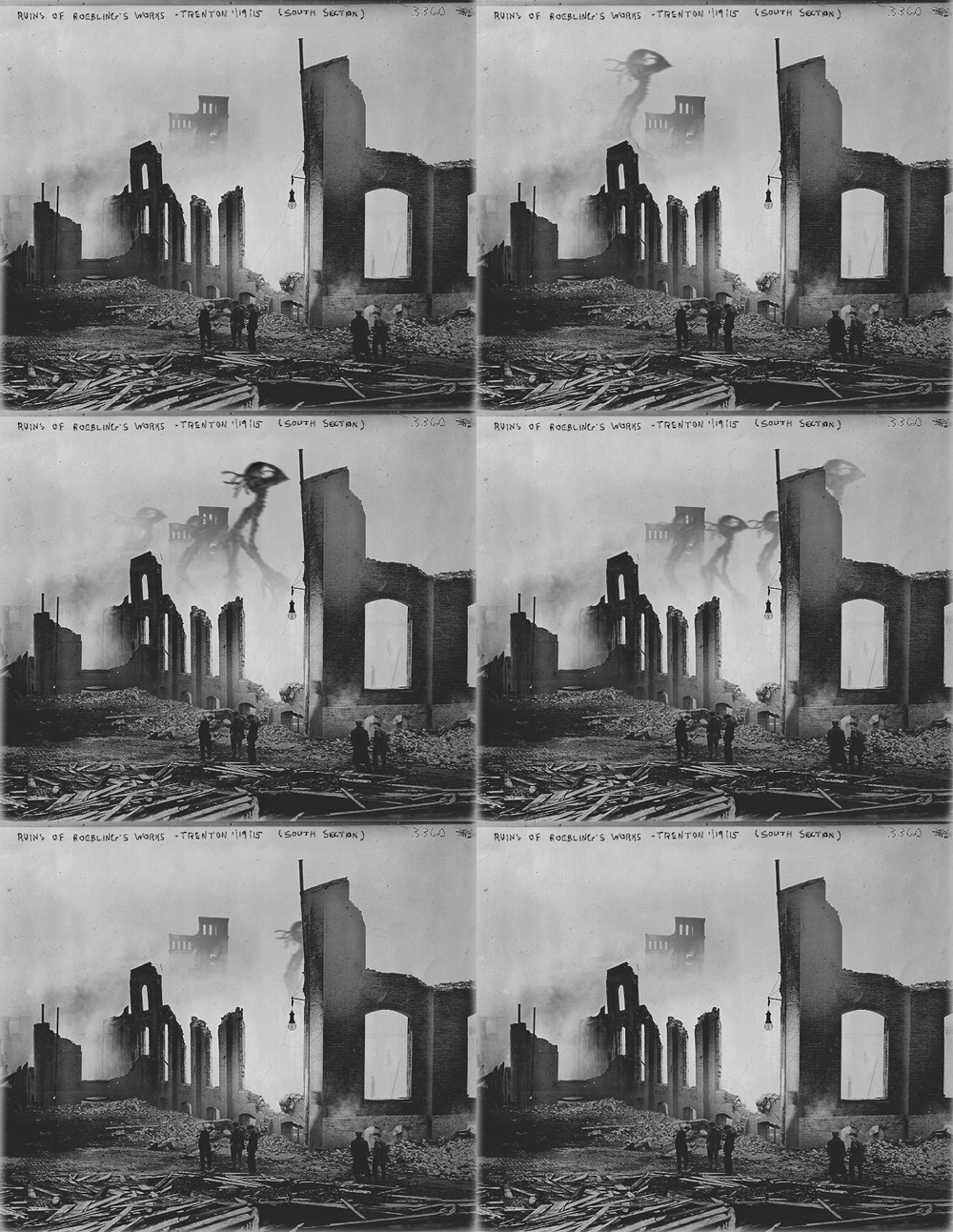
        Artist Kevin Weir takes photographs from the collection of the Library of Congress online archive and converts them to animated GIFs.  The result is somewhat steampunky, and very eerie. Some of them remind me of Terry Gilliam’s animations from Monty Python’s Flying Circus (which is not necessarily a bad thing…).

        The results are thought provoking and definitely worth the time to scroll through them.

        To Rule the Skies — Now available!

        I am happy to announce that my debut novel To Rule the Skies is now available.

        140814 COVERgradient2Set in a Victorian world in which events happened slightly differently, To Rule the Skies is a story of airships and scientists, robber barons and airpirates. I plan this book to be only the first in the Airship Flamel Adventures series.

        Professor Nicodemus Boffin, late of the University of Edinburgh and protégé of the great Michael Faraday, serves as the Scientist General of a semi-secret British institute to further scientific knowledge and technological advancement for Queen, Country, and Empire. Boffin and his crew travel the world aboard their advanced airship Flamel on a voyage of discovery. In desperate times, however, Flamel is called upon to perform “extraordinary duties”. Boffin is tasked to search for the cause of the sinking of HMS Bellerophon, the Royal Navy’s flagship which was secretly carrying a huge gold shipment from the Canadian gold fields to London. He must uncover who or what is behind the disaster before tensions between long-time transatlantic enemies, Britain and the United States, bring the two nations over the brink to all-out war.

        To Rule the Skies is available at Amazon for the Kindle,  iTunes for iBook, and Smashwords in many ebook formats.

        Paperback version coming soon!