Clockwork Alchemy is here!

Clockwork Alchemy is San Jose’s steampunk con and it takes place every Memorial Day weekend (for those not in the US, that’s the last full weekend in May).  That means now!

It actually started today, and I got there just in time to set up my table in “Authors’ Row” to sell my book, To Rule the Skies.  Clockwork has a fairly strong authors panel track, and they gave me the encouragement to write and publish my book. I read a short excerpt from the book at the Book Launching Party this evening and it went over well.

I’m also giving three presentations–“Building Victoria”, about Victorian engineers, “Beyond Darwin”, in which I present the stories of several Victorian age scientists (but NOT Darwin or Tesla), and “The Technology of Steampunk”, reviewing the immense technological changes that occurred during the 19th Century.  Perhaps I’ll expand some of the information into future blog posts!

Whew!  I hope I get a chance to see some of the musical groups, and the Artist’s Bazaar!

The American Widow’s Walk: Explaining Victorian-era Architecture for Steampunk Writers – Part One

An Old House Idiosyncracy from the Cogpunk Steamscribe blog

cogpunksteamscribe's avatarCogpunk Steamscribe

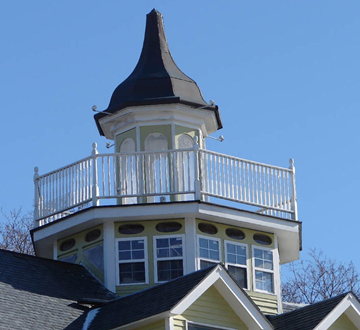
Located in Oak Bluffs (East coast), featured on an episode of This Old House, via Flickr. Wrap around porch and a widow's walk on the roof.

The Widow’s Walk is mainly found on Northern American Victorian-era architecture, though there are examples in other countries. It is called the Widow’s Walk because it is supposedly a place from where wives could keep an eye out for their husbands’ ships. However, since their are many examples of this architectural feature on inland houses without a glimpse of the sea, this is most likely a fabrication.

The Gothic flavour of this myth has all the earmarks of the Victorian obsession with sentimentality:  the patience of the faithful wife; the possibility of lost love; the implied promise of the husband’s return; the gloomy yet poetic name. It was also another excuse to add gingerbread and fretwork to ornament the house; which I suspect was the real reason behind the design and construction of the Widow’s Walk. The classic Widow’s Walk is an ornately fenced rooftop platform often with a enclosed cupola, painted in contrasting colours to the rest of the house…

View original post 107 more words

Fascinating Early Motion Pictures of London

The link below is to an amazing video from Yestervid.com of early motion pictures of London, including the oldest (a view of Trafalgar Square) as well as the earliest recording, on Edison wax cylinder, of the chimes of the Clock Tower.

As interesting as it is to see how much has changed in London over the 100-plus years since most of these motion pictures were taken, it is equally interesting to see how much has not changed.

Also great reference for period costumes!

Yestervid.

Victorian cooking & kitchens (1/4)

A few years ago, I visited the Newport mansions, where the Gilded Age rich spent their languorous summers while plotting which daughter to marry off to any number of impoverished British noblemen. I found the kitchens to be the most interesting parts of the tours–maybe because I could envision real people working in them, in contrast to the over-decorated formal parts of the houses.

19thcentury's avatarthe Victorian era

      Around 1800 the first stove that was made to cook on was developed by Benjamin Thompson, it was called the Rumford Stove. (Up to 1800, stoves were mostly used for heating, not for cooking.) One fire was used to heat several pots, which hung in the fire through various holes on top of the stove. This stove however was too large for domestic use.
     In 1834 the Oberlin Stove was patented in the US, it was the same technique but made smaller for domestic use. In the following 30 years 90,000 units were sold. During this time, the stoves still worked on wood or coal; while gas was available but it wasn’t used until late in the 19th century.
     Towards the end of the 19th century, more and more houses got water and sewer pipes, and also gas pipes (used for light.) These pipes were later used…

View original post 211 more words

Helpless Victorian Ladies? Think again!

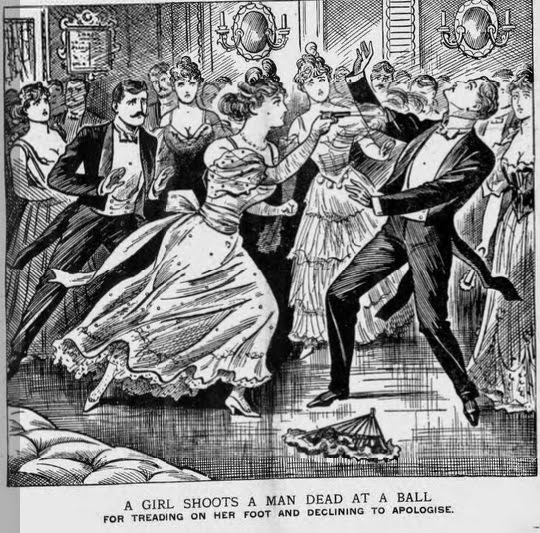
I’m sharing a link to an entertaining post from the blog Strange Company entitled innocently enough, “Newspaper Clipping(s) of the Day” but whose contents belie that bland description.

OK, this woman seems to be over-reacting a bit.

OK, this woman seems to be over-reacting a bit.

Based on clippings from the “Illustrated Police News“, one of the most sensationalist London newspapers of the day, the post contains illustrations of Victorian women taking matters into their own hands when accosted, insulted, or otherwise violated. These ladies are definitely self-rescuing.

I can imagine a female steampunk character emulating these ladies.  In fact, I have a character taking after the woman in March 28, 1896’s drawing when accosted by an evil-doer.

Steampunk at its Design Core

I’ve loved ModVic’s designs ever since I first saw them!

Just like the Victorian era had its “revival” styles–Gothic Revival, Renaissance Revival, etc.–I like to think of the Steampunk Aesthetic as “Victorian Revival”, containing some aspects of Victorian styles, just with a more modern twist.

airshipambassador's avatarAirship Ambassador

by

Bruce Rosenbaum, ModVic LLC


It was not until the Summer of 2008 I first heard the word ‘ Steampunk’. A friend had known about the movement and aesthetic and told me we were Steampunking. The description seemed quite odd to me. I understood the ‘steam’ referenced the steam that generated power for the machines and factories of the Victorian and Industrial Age. It was the word ‘punk’ that gave me pause. It brought to mind the more mischievous days of my youth in Marblehead, Massachusetts, but punk is a designation I thought I had outgrown a long time ago.

My wife, Melanie and I started our home restoration business, ModVic, short for Modern Victorian, in June of 2007. Our vision was to combine the best of the Victorian and Industrial ages by incorporating modern technologies and systems of today’s conveniences with Victorian elegance and design. The idea was…

View original post 315 more words