The Colors of the Past

One of the more interesting ways to while away the hours is by looking at old photographs, especially those from the birth of photography in the mid-1800s. An amazing amount of detail  can be gleaned from a photograph printed from a large glass plate.

But are we really seeing what we think we’re seeing? First off, the images are necessarily monochromatic—black and white. Any color that is seen in black-and-white photographs is a result of hand-tinting the photograph, typically to put some color in the subject’s cheeks. Color photography, although experimented with even early on in photography’s history, was extremely cumbersome, and required laboratory-grade equipment to pull off. Even the great Scottish physicist James Clerk Maxwell thought about color reproduction and what is considered to be the first color photograph was made using a technique he first described.

So we’re left with black-and-white photography for the Victorian Era. But are we really seeing a proper monochromatic reproduction of reality? In most cases, the answer is no. Continue reading
CSI: Victorian London

Take one part Dr. Gregory House, add a bit of Sherlock Holmes and a pinch of modern forensic science, and you have Dr. John Snow, a man who solved one of the largest mass killings in Victorian London.

The culprit: cholera. Ever since it first appeared in Britain in 1831, cholera periodically ravaged the cities, leaving thousands dead in its wake. In 1848-9, over 14,000 Londoners died; in 1853-4, another 10,000 succumbed. That the disease was somehow related to the deplorable conditions of British cities at the time was clear, but the means of transmission was believed by all authoritative men of medicine to be via “miasma”. Miasma was thought to be a sort of poisonous vapor or mist originating from decomposing matter, called miasmata. (Similarly, the word “malaria” comes from the Italian meaning “bad air”.) To prevent outbreaks, it was thought to be a simple matter of removing the miasmata. That many of London’s cholera outbreaks occurred along the banks of the Thames, the stinking fetid pool that was the depository of much of the capital’s sewage, only served as proof of the theory’s validity. Continue reading

507 Mechanical Movements for all kinds of Steampunk Goodness

If you are a mechanical sort, and have an hour or two to while away, may I suggest spending it at 507movements.com, a website that contains an enhanced version of the book of the same name by Henry Brown, which was originally published in 1868. 

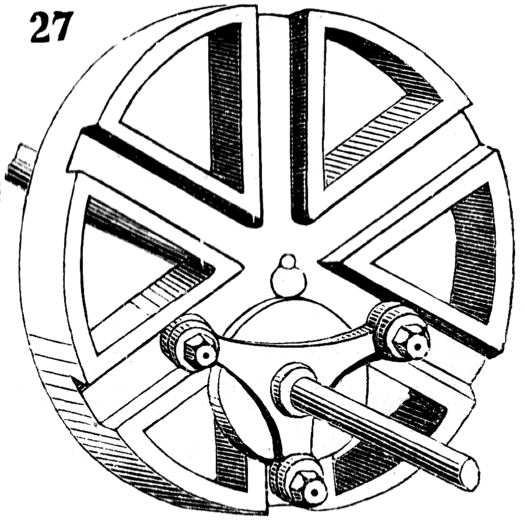
“Multiple gearing”—a recent invention. The smaller triangular wheel drives the larger one by the movement of its attached friction-rollers in the radial grooves.

“Multiple gearing”—a recent invention. The smaller triangular wheel drives the larger one by the movement of its attached friction-rollers in the radial grooves.

The website features the 21st edition of this long-popular technical book which was published in 1908.  (The satisfyingly wordy and descriptive frontispiece of which is roughly reproduced below: Continue reading

Luminosity and Electricity in the Sky

An article by Phil Plait, the “Bad Astronomer” on Slate.com reminded me that today (September 1) is the 155th anniversary of the observation of the solar flare that within a day would cause the Great Auroral Storm of 1859.

This interesting astronomical event is of special interest to me as it is recounted in my upcoming novel “To Rule the Skies”.

Richard Carrington, an English gentleman-scientist and amateur astronomer, was sketching sunspots at the observatory he built at his estate at Redhill, Surrey, part of a survey of sunspots that went back almost a decade. He noted two bright flares emanating from one particular group of sunspots.  As he watched, the flares moved across the surface of the spot, then disappeared.

Carrington's sketch of the sunspot observed on Sept 1., 1859.  Solar flares observed at points A & C moved to points B & D in 5 minutes.

Carrington’s sketch of the sunspot observed on Sept 1., 1859. Solar flares observed at points A & C moved to points B & D in 5 minutes.

It was later noted that Carrington’s observation coincided with a deviation in the Earth’s magnetic field measured at Kew Observatory. But more importantly, in the next few days, all hell broke loose in the sky. Continue reading