The Art of Travel

A couple of years ago in a panel I did on Victorian Scientists at Clockwork Alchemy, the San Jose Steampunk con, I talked about Francis Galton. “Who?” you may ask. Francis Galton may be the most talented Victorian Scientist that no one has ever heard about today. The breadth of his work is jaw-droppingly astounding. Born in 1822 into the celebrated Wedgwood-Darwin clan (and half-cousin to Charles Darwin), he had all the advantages of a Victorian gentleman, including a wealthy father who died young leaving him with the means to be a gentleman-scientist for the rest of his life.

Young Francis was a child prodigy, reading by age two and knowing Greek and Latin by his fifth birthday. He was impatient with formal schooling, however, and bounced around aimlessly from school to school. He eventually earned an undistinguished degree from Cambridge, but only after suffering a nervous breakdown. Upon the death of his father, he left his studies and turned to travel, science, and invention.

Francis Galton in the 1850s
Francis Galton in the 1850s

Continue reading

Did Mark Twain and Charles Dickens Ever Meet?

Mark Twain and Charles Dickens were arguably the greatest writers of the 19th century in America and Britain, respectively, and were certainly the most popular. Their careers follow a sort of parallel route as both used their stories to highlight the plight of the downtrodden, and both used the skewer of humor to deflate puffed-up authority figures. A question came up in a writer’s panel I once attended pondering whether they ever met. It turns out I’ve done a little bit of research into that very question.

I’m fascinated in instances of famous historical personages meeting, and the stories behind them. The famous photo of Nixon posing with Elvis in the Oval Office always comes to mind, although there are many other famous meet-ups in history. Continue reading

The Colors of the Past

One of the more interesting ways to while away the hours is by looking at old photographs, especially those from the birth of photography in the mid-1800s. An amazing amount of detail  can be gleaned from a photograph printed from a large glass plate.

But are we really seeing what we think we’re seeing? First off, the images are necessarily monochromatic—black and white. Any color that is seen in black-and-white photographs is a result of hand-tinting the photograph, typically to put some color in the subject’s cheeks. Color photography, although experimented with even early on in photography’s history, was extremely cumbersome, and required laboratory-grade equipment to pull off. Even the great Scottish physicist James Clerk Maxwell thought about color reproduction and what is considered to be the first color photograph was made using a technique he first described.

So we’re left with black-and-white photography for the Victorian Era. But are we really seeing a proper monochromatic reproduction of reality? In most cases, the answer is no. Continue reading

Eerie Animated GIFs

tumblr_nbpb85vvRv1qlq9poo3_500

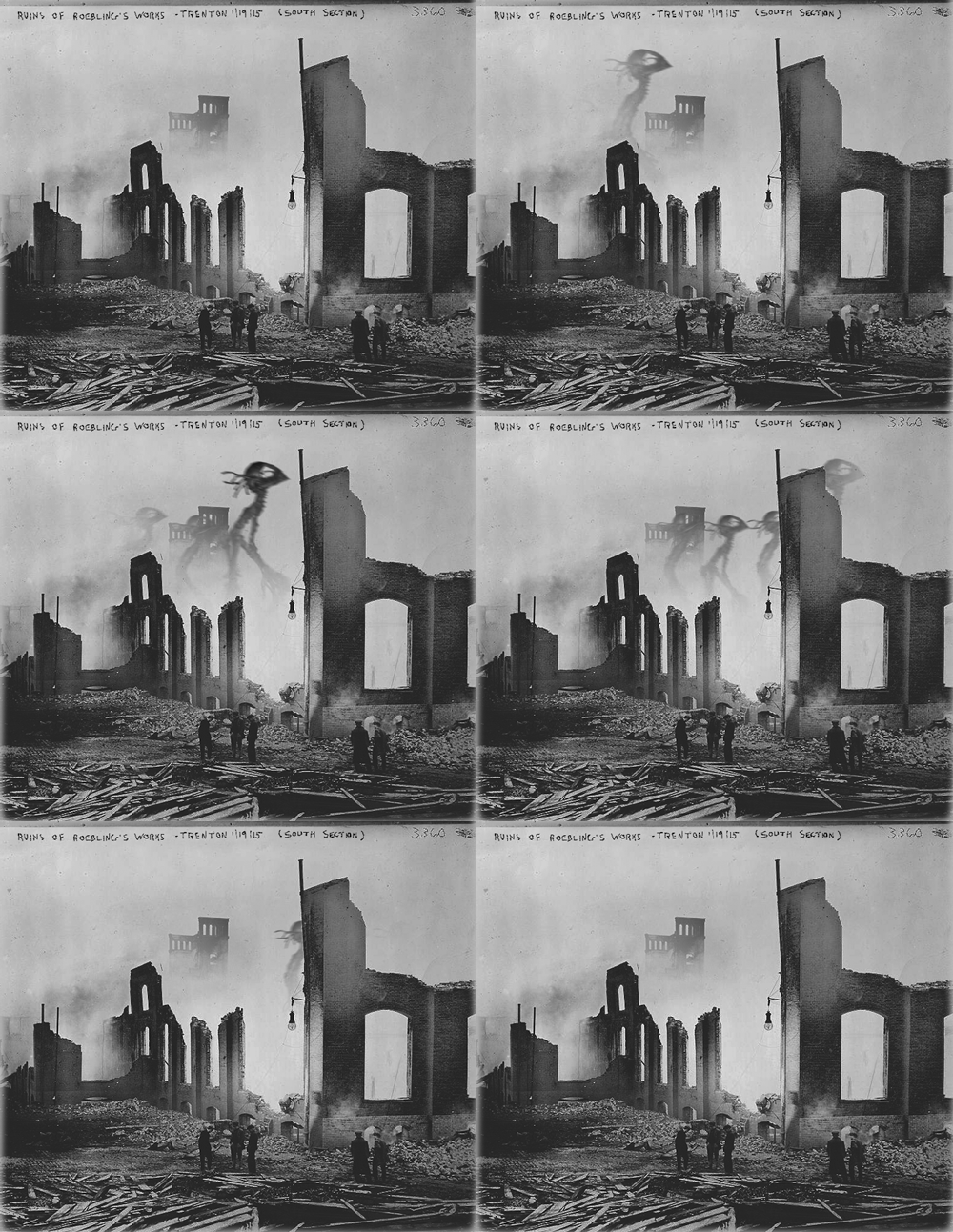
Artist Kevin Weir takes photographs from the collection of the Library of Congress online archive and converts them to animated GIFs.  The result is somewhat steampunky, and very eerie. Some of them remind me of Terry Gilliam’s animations from Monty Python’s Flying Circus (which is not necessarily a bad thing…).

The results are thought provoking and definitely worth the time to scroll through them.

CSI: Victorian London

Take one part Dr. Gregory House, add a bit of Sherlock Holmes and a pinch of modern forensic science, and you have Dr. John Snow, a man who solved one of the largest mass killings in Victorian London.

The culprit: cholera. Ever since it first appeared in Britain in 1831, cholera periodically ravaged the cities, leaving thousands dead in its wake. In 1848-9, over 14,000 Londoners died; in 1853-4, another 10,000 succumbed. That the disease was somehow related to the deplorable conditions of British cities at the time was clear, but the means of transmission was believed by all authoritative men of medicine to be via “miasma”. Miasma was thought to be a sort of poisonous vapor or mist originating from decomposing matter, called miasmata. (Similarly, the word “malaria” comes from the Italian meaning “bad air”.) To prevent outbreaks, it was thought to be a simple matter of removing the miasmata. That many of London’s cholera outbreaks occurred along the banks of the Thames, the stinking fetid pool that was the depository of much of the capital’s sewage, only served as proof of the theory’s validity. Continue reading

30 Days of Filth

Writing historical fiction, or even alternate historical fiction (or is it alternate fictional history?) as I have been, requires lots of research. In order to create a believable world, you have to get the details right. Or at least make them sound plausible.

For those interested in the Victorian Era, and especially Victorian London, a great source of that kind of detailed information is the website of Lee Jackson, Victorian London, which comprise his Dictionary of Victorian London, his blog The Cat’s Meat Shop, links to purchase his ebooks on Victorian London, and his photography of bits of Victorian London that have somehow survived to the present.

I’ve used this website extensively in researching my book, and it has not failed yet to provide some insight on a specific tidbit I was curious about.

At the moment, Lee Jackson is in the midst of a blog countdown titled, “30 Days of Filth” , marking the publication of his book “Dirty Old London–The Victorian Fight Against Filth”. Today is Day 9 and the blog talked about “Climbing Boys” the youngsters “apprenticed” to chimney sweeps to climb up the chimney flues.

Previous days have included essays about such manner of things as the London sewer system and what it replaced, how to pack more dead bodies into overflowing churchyards, and nude bathing in Hyde Park. The series so far is deliciously filthy, sooty, and muddy, and reeks of sulphurous emanations. This blog (and the upcoming book) will disabuse you of any sunlit fantasies of “the Good Old Days”.

DirtyOldLondon

Luminosity and Electricity in the Sky

An article by Phil Plait, the “Bad Astronomer” on Slate.com reminded me that today (September 1) is the 155th anniversary of the observation of the solar flare that within a day would cause the Great Auroral Storm of 1859.

This interesting astronomical event is of special interest to me as it is recounted in my upcoming novel “To Rule the Skies”.

Richard Carrington, an English gentleman-scientist and amateur astronomer, was sketching sunspots at the observatory he built at his estate at Redhill, Surrey, part of a survey of sunspots that went back almost a decade. He noted two bright flares emanating from one particular group of sunspots.  As he watched, the flares moved across the surface of the spot, then disappeared.

Carrington's sketch of the sunspot observed on Sept 1., 1859.  Solar flares observed at points A & C moved to points B & D in 5 minutes.

Carrington’s sketch of the sunspot observed on Sept 1., 1859. Solar flares observed at points A & C moved to points B & D in 5 minutes.

It was later noted that Carrington’s observation coincided with a deviation in the Earth’s magnetic field measured at Kew Observatory. But more importantly, in the next few days, all hell broke loose in the sky. Continue reading