Admiral Byrd’s Snow Cruiser

The Snow Cruiser and its crew in Antarctica.

The Victorian Era corresponds well with an age of exploration–exploration of the Poles, as well as Africa and the Far East, not to mention the first ascension of many mountain peaks. And of course, it overlaps with the time frame in which much steampunk literature takes place.

Exploration of the Polar Regions started in the 1800s with the search for the Northwest Passage, and continued into the 20th century. The North Pole was overflown on  May 9, 1926 by the American Admiral Richard Byrd in a Fokker Tri-motor plane, although there is some dispute concerning the accuracy and precision of the sextants used and whether the plane could have flown the distance claimed. Nevertheless, a Norwegian expedition commanded by Roald Amundsen reached the pole three days later in the airship Norge cementing the achievement of this goal for good.

Admiral Byrd commanded several Antarctic expeditions over the decades from the 1930s to the 1950s. On his third expedition, Byrd delivered what he hoped would be an innovative vehicle, the Antarctic Snow Cruiser to the Little America base.  The vehicle was designed by Thomas Poulter, a veteran of Byrd’s previous expedition, and was built at the Pullman Company. Its dimensions were huge: 17 meters long and 61 meters wide. During its journey to Boston where it was to be loaded onto the ship to Antarctica, its size caused steering problems, not to mention traffic jams in the cities it passed through.

Cut-away view of the Snow Cruiser showing its capabilities.

The Snow Cruiser was designed to extend the range of exploration from the main base of Little America on the Ross Ice Shelf. The Snow Cruiser had living quarters for a crew of five and included sleeping areas, a galley, a machine shop, and a photographic darkroom. More exciting was the biplane that the Cruiser carried to increase its exploration range even further.

When the Snow Cruiser was unloaded from the Coast Gard Cutter North Star at Little America base, problems became evident. The immense weight of the vehicle was such that the ramp from the ship’s deck collapsed. The ten-foot diameter tires were designed to be treadless to prevent encrustation by snow. However, they provided little traction. The tires also sunk into the snow as much as 1-meter deep. Several modifications were tried to improve driving performance, and it was found that driving in reverse increased traction to some extent. However, the Snow Cruiser’s longest trek was only 148 km, accomplished completely in reverse. The biplane did perform some aerial surveys of the area near the Little America base, but not as much as originally expected.

A skeleton crew over-wintered in the Cruiser performing scientific observations. By the next spring, the US government was more concerned with the growing threat of war, and Antarctic exploration was halted. The Cruiser became buried in the snow and eventually the ice shelf where it stood broke away. While it is not known where exactly the Cruiser ended up, it is certain that it now lies on the seabed.

While the Snow Cruiser did not reach its potential, it is still a great example of innovation being harnessed for science, a feature that has continued from the Victorian Age, all the way up to the Apollo moon missions and Ingenuity, the robotic helicopter that just finished its mission flying around on Mars.


End of the Year Discounts on Smashwords

From December 15 to the end of January 1, the four issues in the Airship Flamel Adventures Series will be discounted on Smashwords for half-price (or $1.74 for the electronic versions of these books.) And the Anteprologue to the first book in the series is available free!

The main character (our hero!) is Professor Nicodemus Boffin, who commands the airship Flamel, an airship which contains all manner of advanced technologies, much invented by the professor himself. The Flamel travels the world on an extended voyage of discovery. At times, however, Flamel and its crew are called upon to undertake “extraordinary duties” for Queen, Country, and Empire.

Click on the titles below to read more about this steampunk adventure series.

Enjoy!

Glamping–1910s-style

Summer is approaching and thoughts turn to time spent in the great outdoors, if not exactly in the wilderness.

Here’s an interesting recent article from the New England Historical Society entitled “Thomas Edison Tries to go Camping in New Hampshire“. While the time is a bit later than what is typically considered steampunk, it should give some ideas on just how to mount a camping trip with all the bells, whistles, and that a steampunk with an infinite amount of money and technological acumen might expect.

And if you’re interested in period camping equipment, here’s a vintage equipment catalog to get you started.

Where Treasures Lie — Now available as an Ebook!

I was pushing so fast to finish the final formatting of the paperback version of my latest book in the Airship Flamel Adventures–Where Treasures Lie–that I put off formatting it for various other ebook formats that are not Kindle (Apple, Barnes and Noble, Kobo, etc). That hole has now been filled! The book is now available on Smashwords.com in many different ebook formats.

Happy Reading!

Where Treasures Lie – Now Available!

I am happy to announce that my latest novel in the Airship Flamel Adventures series is now available on Amazon in paperback and Kindle versions.

Here’s the synopsis:

Jonathan Boffin runs away from school one day and stows away on an airship in hopes of following his dream to become an airpirate. Captain MacNee takes him under his wing and employs him as a cabin boy while teaching him airmanship and piracy.

Years later, Jonathan, now Airpirate Captain Jonathan Blackguard plunders an ancient map from a prize ship. He quickly discovers that he lacks the skill in interpreting it. Only the large red X in the center of the map tempts him to continue seeking the secret of the map and the treasure that must lie where the X marks the spot. Eventually he concedes that only one person has both the intelligence and the integrity to help him decipher the secret of the map: his father, Professor Nicodemus Boffin, from whom Blackguard ran away from. But will his father put aside years of estrangement in hopes that working with his son will bring him around to his father’s point of view? And what will the treasure turn out to be?

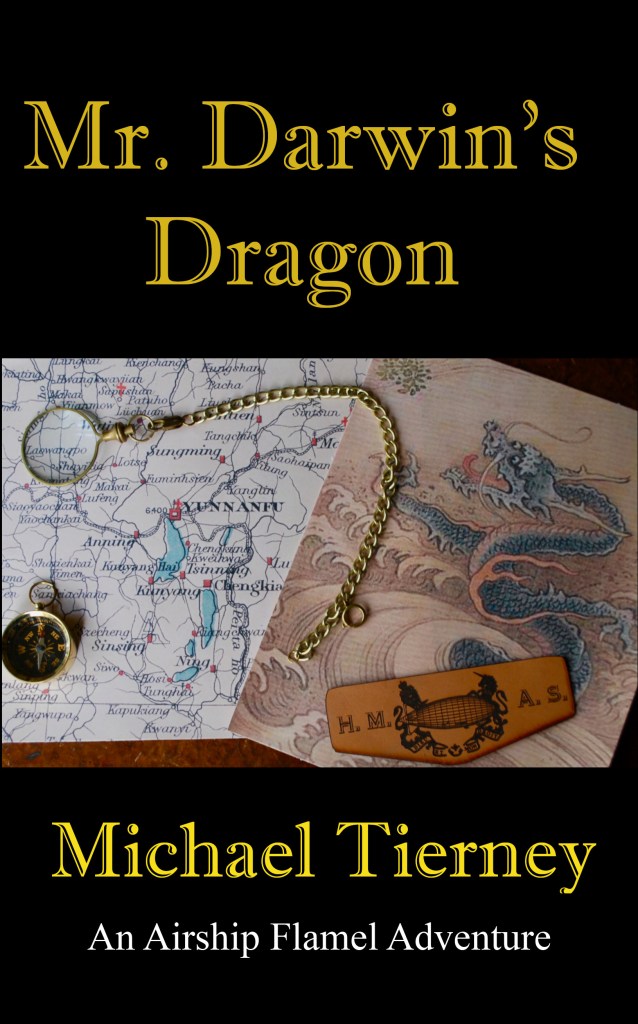
As opposed to my previous books, this story is told somewhat more from Jonathan’s point of view and features his disagreements with his father.  This book completes the three-story arc–The Secret Notebook of Michael Faraday, Mr. Darwin’s Dragon, and Where Treasures Lie, although To Rule the Skies takes place after this book. And I would not be too surprised if another book with the same characters crossing paths with a famous scientist or two at some point.

The book will be launched next weekend (April 7-9) at Clockwork Alchemy, the Bay Area’s steampunk con. I’ll be at the Author’s Alley along with a number of my fellow authors. I’ll be also giving two presentations–on Steampunk Architecture and on Victorian Scientists. Since the theme of the con this year is Villains and Heroes, I’ll be sorting things along those lines. And there were plenty of villainous scientists and engineers during the Victorian Era to keep things interesting.

Steampunk Cuisine, Part 1. Pressure Cookers

I’ve been involved in Steampunk for over seven years, but it wasn’t until this year that I realized that there’s not much in the way of steampunk cuisine. I’m not sure exactly why this is– most steampunks I know certainly enjoy eating, and a good number enjoy cooking as well.

Sure there are plenty of steampunk beverages–tea, of course, as well as various libations of the alcoholic persuasion–rum, gin, absinthe–depending on how fancy you feel. But there is a dearth of steampunk-related foods.

I hope to remedy this deficiency.

Let’s start with what I consider the most steampunk piece of kitchen hardware–one that uses the mighty power of steam itself to cook your food. I am speaking, of course, of what was once known as the “pressure cooker” and is now branded as the Instant Pot. They consist of a pot with a sealed lid that when heated pressurizes the contents of the pot.

So how do these infernal devices work? At normal atmospheric pressure, water boils at 100C (212 F for you American non-scientists). However, remember the Ideal Gas Law from freshman chemistry (PV = nRT). Because the pressure cooker is sealed, the internal pressure (P) rises as the temperature increases and thus, the boiling point of the water in the cooker rises. So the water inside now boils at about 121C (250F). Higher temperature means faster cooking.

Of course, the higher pressure could mean a higher risk of explosion if the pressure cooker isn’t equipped with a pressure-relief valve or if it gets clogged with what’s being cooked. I can remember my mother cooking with a 1970s era pressure cooker and feeling a vague sense of imminent danger from the hissing, steaming device. Modern Instant Pots seem to be safer.

Vintage Pressure Cookers

The photos above show some vintage pressure cookers, and it should be obvious just how steampunk they look. The cooker’s lid is kept sealed by sturdy clamp bolts. The lid itself is festooned with pressure and temperature gauges as well as pressure relief valves to release excess steam and prevent unwanted explosions.

I haven’t jumped on the Instant Pot bandwagon. Perhaps the memories of my mother’s pressure cooker steaming away on the stove has hindered me. Still, my search for steampunk cooking continues unabated.

My next installment about Steampunk Cuisine will come next week. In the meantime, if you’ve got any good ideas for steampunk recipes, please leave them in the Comments section below.

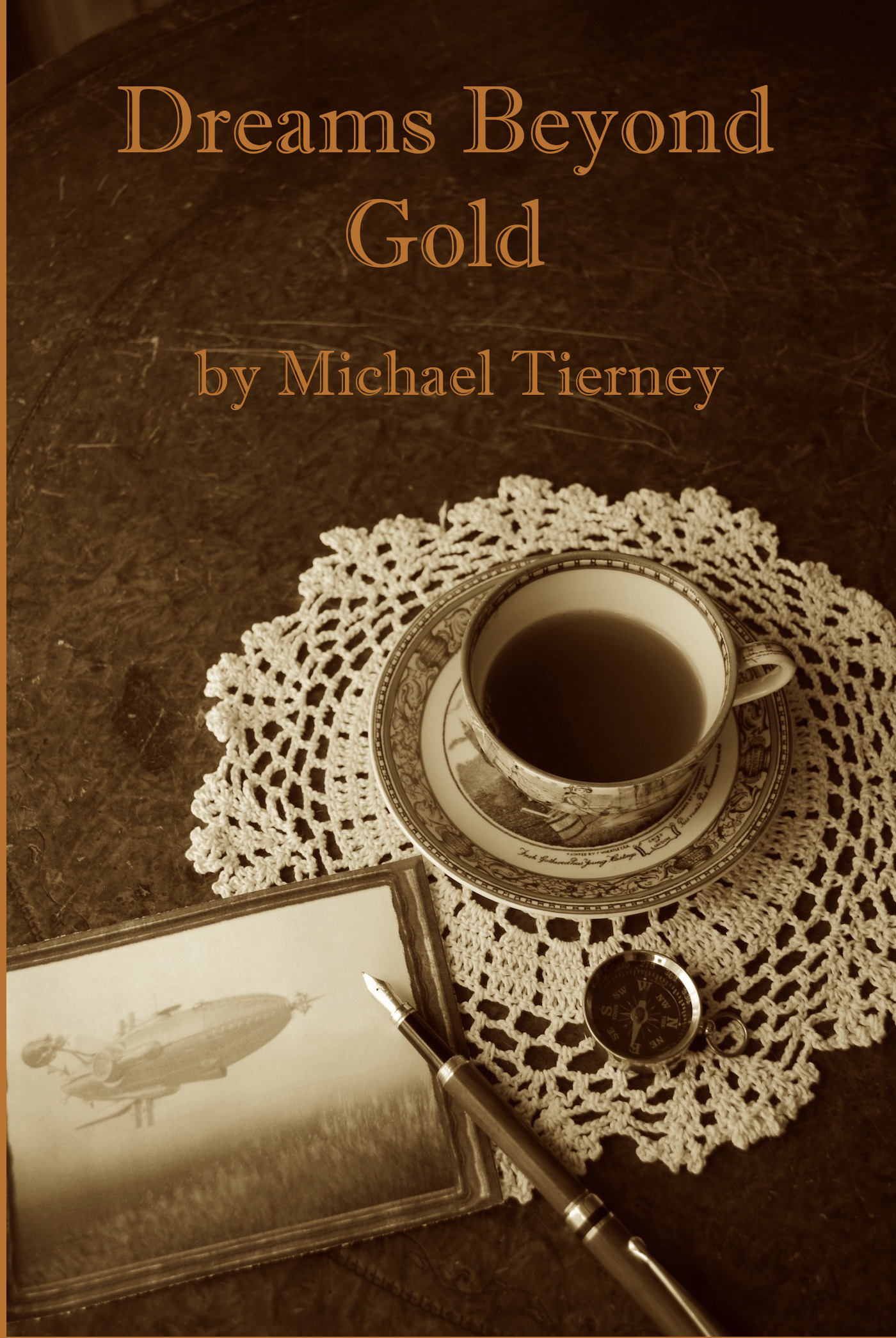
Did you enjoy this blog post? Interested in more? My new FREE short story “Dreams Beyond Gold” is available HERE. It’s the tale of an airship rpirate captain who is looking to try his hand at more literary pursuits.

You will also be signed up to receive my periodic newsletter with information on my writing, as well as other interesting tidings. And I pledge: No Spam.

“Dreams Beyond Gold”– A new FREE short story from Michael Tierney

Captain Jack Fawkes is a feared airpirate captain. Even though he has gained much renown and bounteous treasure from raiding airships, he is beginning to feel somewhat tired of the marauding life, and looking to try his hand at more literary pursuits. How will he manage to escape his airship without his crew realizing that he is giving up his former life—and the treasures he earns for them? It’s a tale of swashbuckling adventure along with a bit of humour.

“Dreams Beyond Gold” is available HERE. You will also be signed up to receive my periodic newsletter with information on my writing, as well as other interesting tidings. And I pledge: No Spam.

Welcome aboard!