The Harrison Clocks

A recent post on the Two Nerdy History Girls blog prompted me to remember the wonderful book “Longitude” by Dava Sobel chronicling the history of John Harrison and his lifelong pursuit to develop an accurate chronometer.

In 1714, the Royal Navy had a problem.  Although it was a rather simple procedure to determine the latitude of a ship at sea (by sighting angle of the the sun at noon or Polaris, the North Star, at night), it was exceedingly difficult to determine a ship’s longitude.  After several maritime disasters resulting from faulty navigation, Parliament passed the Longitude Act which offered monetary rewards for methods to determine longitude at sea.

Continue reading

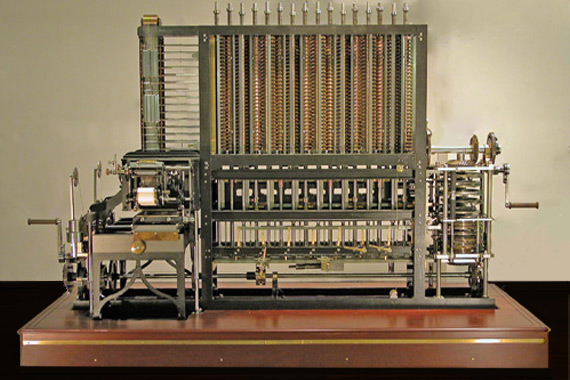
Fantastic Devices to Improve your Steampunk Reality: The Difference Engine

This post ponders a topic that I consider when writing Steampunk/Alternate History: How much real (vs. fantastical) science and technology to include in your writing.

jgriswoldauthor's avatarAirships, Automatons, and Aliens...Oh My!

image

Airships. Steam powered trains. Carriages drawn by mechanical horses, or self-propelled. When most people think of steampunk, these types of images frequently come to mind. Often these images are accompanied by automatons running amok, strange contraptions that bare little, if any resemblance to devices that currently exist, filled with cogs, gears and springs.

When it comes to the technology of a steam punk reality, the expectation seems to be big and impressive. But perhaps in a reality where the steam engine never gave way to the modern internal combustion engine, there is still a chance of a similar technological revolution. Perhaps in a world of steampunk, the world would be forever changed by a single device. A device that could take complex data and simplify it, translating it into information that the common man could use. We have the computer; our steampunk counterparts might have The Difference Engine.

For one…

View original post 448 more words

Goldsworthy Gurney–Gentleman Scientist

Goldsworthy_Gurney_-_PD-OLDSir Goldsworthy Gurney is a prime example of that most Victorian of species: the gentleman scientist.  A man of independent means who did not actually need to work to earn his living, and who possessed a scientific mind could make a fair contribution to inventing the 19th century. Such a man was Gurney.

He invented the limelight–a lamp which glowed when heated with an oxygen/hydrogen flame and used to enduring fame in lighting actors on stage.

In the 1820s he invented a steam carriage and proved that it could travel long distances even over the rough roads of the day.

In 1856, he patented an improved heater, called the Gurney Stove, some of which are still in use to this day!

Here’s a link to an article on the BBC website about this interesting and not-very-well-known man.

John Tyndall—The Man who Discovered the Answer to “Why is the Sky Blue?”

John_Tyndall_1I am often amazed by Victorian scientists and engineers who seem to have had infinite curiosity, wide-ranging interests, and, somehow, the time to make pioneering contributions in a number of disparate fields. Francis Galton, Michael Faraday, and Isambard Kingdom Brunel are all examples of these larger-than-life characters. So is John Tyndall.

“Who?” you say. If you ever took an introductory chemistry class, you might remember the “Tyndall Effect” describing how light is scattered in a colloid or another solution containing small particles. It may seem like a pretty narrow and arcane scientific achievement, but as I will describe, light scattering is pretty important, and besides, it was only one of many achievements from this most Victorian of scientists.

John Tyndall was born in Ireland of an English family in 1820. He attended the local schools, learning amongst other things, drafting. This knowledge came into good stead when he was hired by the Irish Ordnance Survey. As the British railways were being built in the 1840s, there was a great demand for surveyors, prompting Tyndall to work for several years in Britain in railway construction planning.

After railway work slackened and intellectual pursuits called him, he left Britain for Germany to further his education in science. At the time, British universities focused on classics and mathematics, and not practical science, whereas Germany schools were known to be more advanced in the practical sciences.

Tyndall landed at the University of Marburg, where he studied under, amongst other people, Robert Bunsen, of Bunsen Burner fame. During his time in Germany, he became adept at experimental and laboratory procedures in a number of different scientific disciplines. Continue reading

Horrible Histories–Charles Darwin

Charles Darwin is one of Steampunk’s favorite scientists and rightly so for his revolutionary ideas concerning evolution, not to mention his prodigious beard.  While his adventures on the HMS Beagle make for great reading, On the Origin of Species can be deadly dull reading.

Fortunately, along came the award-winning BBC “children’s” TV show Horrible Histories.  I’ve put the quotation marks there because it’s just as entertaining for adults, at least this adult. You can find lots of excerpts and some entire episodes on YouTube (although it looks like you have to pay for the full episodes). Continue reading