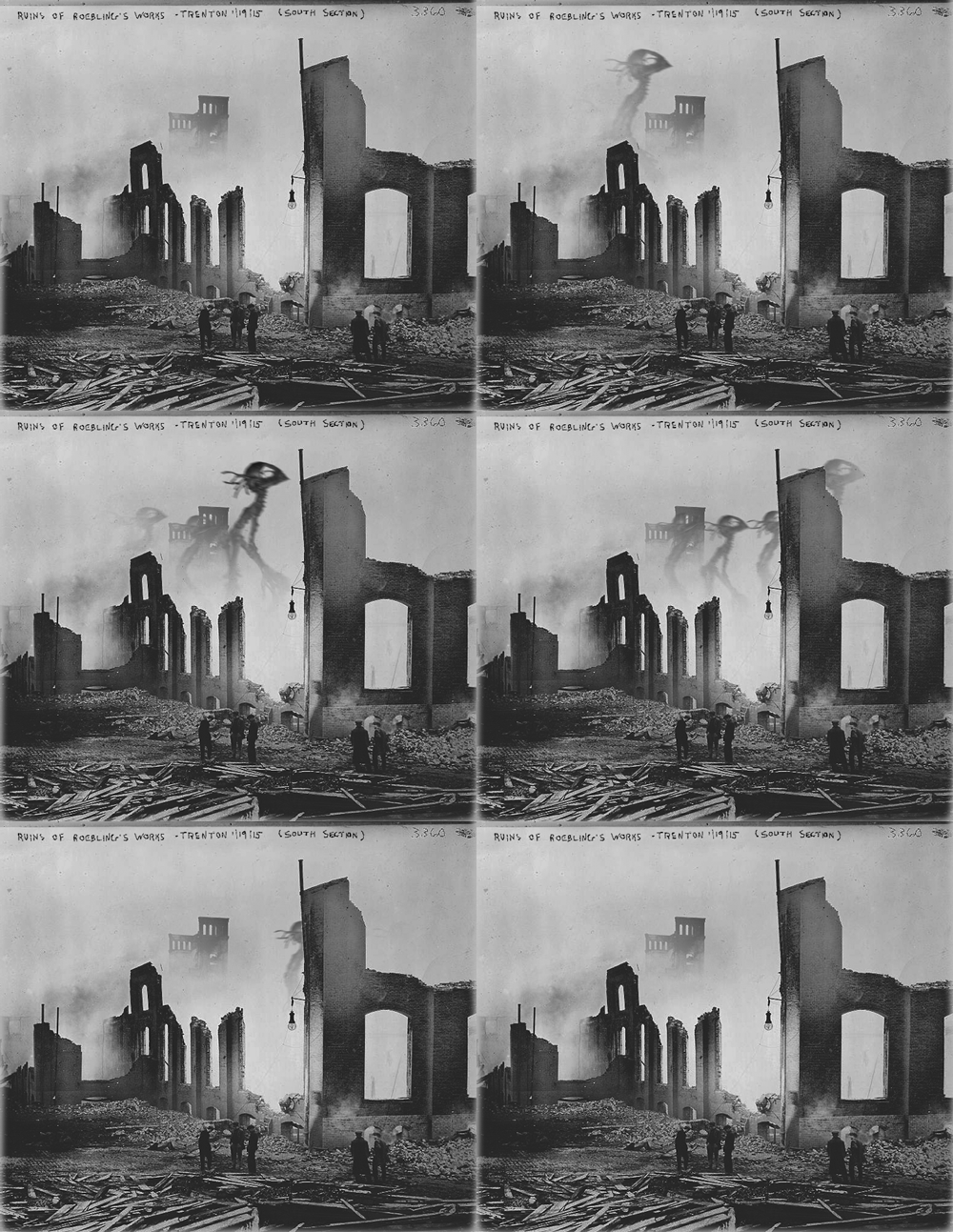
Eerie Animated GIFs

tumblr_nbpb85vvRv1qlq9poo3_500

Artist Kevin Weir takes photographs from the collection of the Library of Congress online archive and converts them to animated GIFs.  The result is somewhat steampunky, and very eerie. Some of them remind me of Terry Gilliam’s animations from Monty Python’s Flying Circus (which is not necessarily a bad thing…).

The results are thought provoking and definitely worth the time to scroll through them.

CSI: Victorian London

Take one part Dr. Gregory House, add a bit of Sherlock Holmes and a pinch of modern forensic science, and you have Dr. John Snow, a man who solved one of the largest mass killings in Victorian London.

The culprit: cholera. Ever since it first appeared in Britain in 1831, cholera periodically ravaged the cities, leaving thousands dead in its wake. In 1848-9, over 14,000 Londoners died; in 1853-4, another 10,000 succumbed. That the disease was somehow related to the deplorable conditions of British cities at the time was clear, but the means of transmission was believed by all authoritative men of medicine to be via “miasma”. Miasma was thought to be a sort of poisonous vapor or mist originating from decomposing matter, called miasmata. (Similarly, the word “malaria” comes from the Italian meaning “bad air”.) To prevent outbreaks, it was thought to be a simple matter of removing the miasmata. That many of London’s cholera outbreaks occurred along the banks of the Thames, the stinking fetid pool that was the depository of much of the capital’s sewage, only served as proof of the theory’s validity. Continue reading

Luminosity and Electricity in the Sky

An article by Phil Plait, the “Bad Astronomer” on Slate.com reminded me that today (September 1) is the 155th anniversary of the observation of the solar flare that within a day would cause the Great Auroral Storm of 1859.

This interesting astronomical event is of special interest to me as it is recounted in my upcoming novel “To Rule the Skies”.

Richard Carrington, an English gentleman-scientist and amateur astronomer, was sketching sunspots at the observatory he built at his estate at Redhill, Surrey, part of a survey of sunspots that went back almost a decade. He noted two bright flares emanating from one particular group of sunspots.  As he watched, the flares moved across the surface of the spot, then disappeared.

Carrington's sketch of the sunspot observed on Sept 1., 1859.  Solar flares observed at points A & C moved to points B & D in 5 minutes.

Carrington’s sketch of the sunspot observed on Sept 1., 1859. Solar flares observed at points A & C moved to points B & D in 5 minutes.

It was later noted that Carrington’s observation coincided with a deviation in the Earth’s magnetic field measured at Kew Observatory. But more importantly, in the next few days, all hell broke loose in the sky. Continue reading

The Thames Tunnel

During the Victorian Age, when science and technology advanced at a rapid pace, many engineering projects were novel and revolutionary.  The Thames Tunnel was one such groundbreaking (pun intended) engineering feat of the Victorian Age, and the one upon which the great Victorian engineer, Isambard Kingdom Brunel, cut his teeth. Continue reading

Beautiful Scientific Illustrations on Retronaut

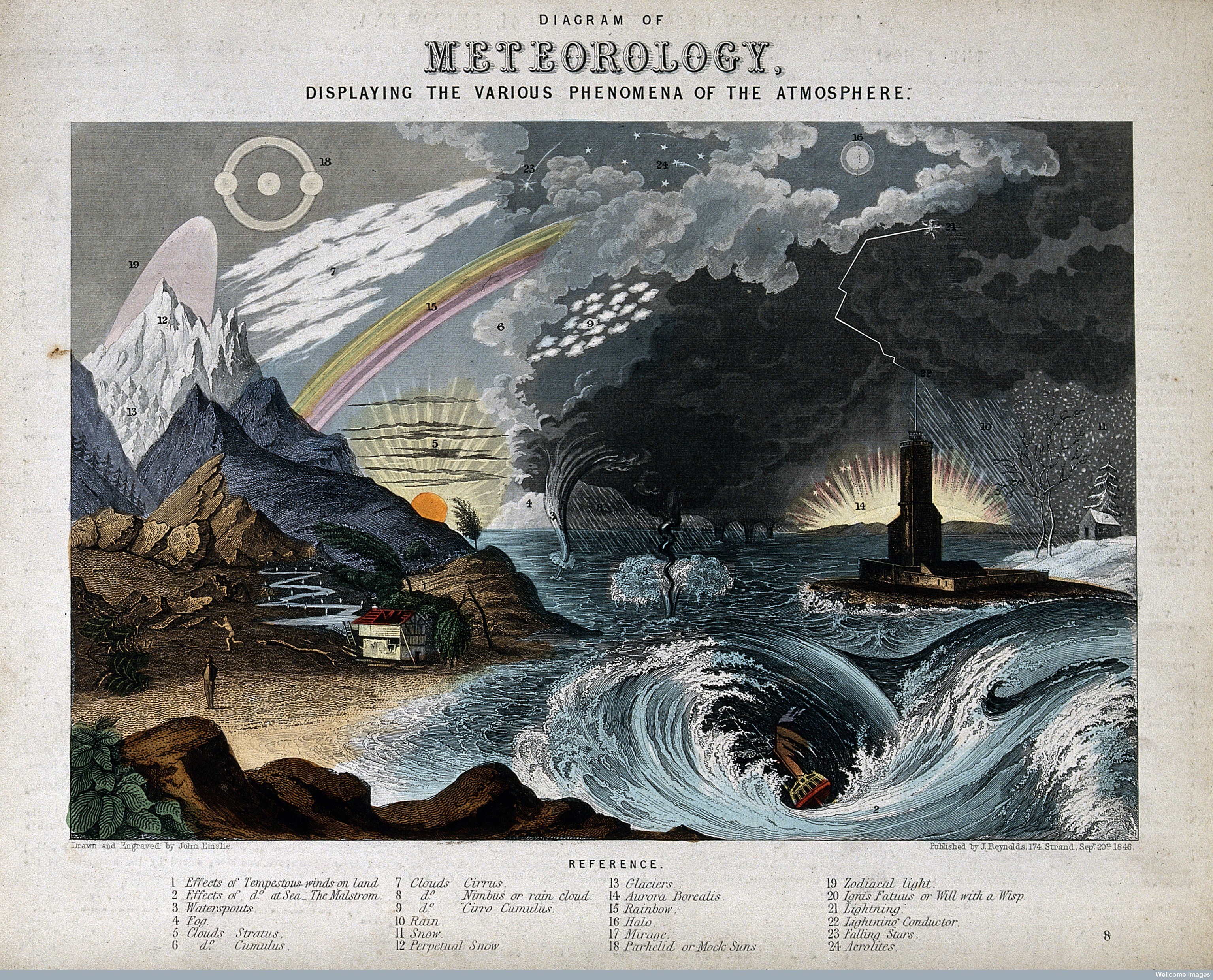
V0025020 Astronomy: a diagram of various atmospheric effects. Coloure

If you’re not familiar with the website Retronaut  (and you really should be), it’s a collection of all manner of vintage photographs and illustrations spanning millenia. One can easily spend vast amounts of time perusing this site!

The site recently featured a number of beautiful colored engravings on scientific topics by John Philipps Emslie, a Victorian age illustrator.  I find his work beautiful and strangely modern in the methods he uses to impart information. Reproduced above is his Diagram of Meteorology.  Retronaut has a couple of collections of his work.

Infographics of the Natural World

Scientific Diagrams

Enjoy!

Welcome!

Welcome to the first post on my Airship Flamel Blog.

Why the name Airship Flamel? The Airship Flamel, or more accurately, Her Majesty’s Research Airship Flamel, is the conveyance of one Professor Nicodemus Boffin, Scientist General of what is called by default “The Endeavour”, as no better name could be agreed upon.

And who might this Boffin fellow be? Only the protagonist in my upcoming novel To Rule the Skies, a story of adventure, daring exploits, and Science! I discussed the genesis of this story in a guest blog post I did for T.E. MacArthur’s The Volcano Lady blog.  last November. In short, Professor Nicodemus Boffin is a British scientist tasked by Her Majesty’s Government to increase the scientific knowledge and technical might of the Empire. As it happens, the unique abilities of Boffin and the crew of the Airship Flamel are often utilized for other, more dangerous missions.

I will talk about Professor Boffin much more in the coming months as the book approaches publication. But I don’t expect this blog to be solely about my books (Yes, books (plural). There is one additional book in progress, a prequel to To Rule the Skies, and several more floating around in my head. It’s not a coincidence that the book is subtitled An Airship Flamel Adventure…) I hope this blog will also be a source of useful and enjoyable topics of interest to the readers of my books–science, history, steampunk, history of science, science of history, steampunk science, Victoriana, making…you get the idea.

I am pleased that you have found your way here. I promise many adventures to come.