End of the Year Discounts on Smashwords

From December 15 to the end of January 1, the four issues in the Airship Flamel Adventures Series will be discounted on Smashwords for half-price (or $1.74 for the electronic versions of these books.) And the Anteprologue to the first book in the series is available free!

The main character (our hero!) is Professor Nicodemus Boffin, who commands the airship Flamel, an airship which contains all manner of advanced technologies, much invented by the professor himself. The Flamel travels the world on an extended voyage of discovery. At times, however, Flamel and its crew are called upon to undertake “extraordinary duties” for Queen, Country, and Empire.

Click on the titles below to read more about this steampunk adventure series.

Enjoy!

Where Treasures Lie — Now available as an Ebook!

I was pushing so fast to finish the final formatting of the paperback version of my latest book in the Airship Flamel Adventures–Where Treasures Lie–that I put off formatting it for various other ebook formats that are not Kindle (Apple, Barnes and Noble, Kobo, etc). That hole has now been filled! The book is now available on Smashwords.com in many different ebook formats.

Happy Reading!

“Dreams Beyond Gold”– A new FREE short story from Michael Tierney

Captain Jack Fawkes is a feared airpirate captain. Even though he has gained much renown and bounteous treasure from raiding airships, he is beginning to feel somewhat tired of the marauding life, and looking to try his hand at more literary pursuits. How will he manage to escape his airship without his crew realizing that he is giving up his former life—and the treasures he earns for them? It’s a tale of swashbuckling adventure along with a bit of humour.

“Dreams Beyond Gold” is available HERE. You will also be signed up to receive my periodic newsletter with information on my writing, as well as other interesting tidings. And I pledge: No Spam.

Welcome aboard!

Mooring Airships on the Empire State Building?

One oft-told story involves the use of the Empire State Building as a mooring mast for airships like the Hindenburg.  It sounds plausible. The spire of the Empire State Building certainly resembles a mooring mast, and if King Kong is not scaling the building, it appears that there’s plenty of room to moor. And no self-respecting steam- or diesel-punk would forgo the chance of mooring his airship at the Art Deco splendor of the Empire State Building.

However, oft-told stories can take on a life of their own in the cold and windy light of day.

The 1930s were the heyday of lighter-than-air dirigibles with the German airships Graf Zeppelin and Hindenburg flying travelers around the globe in luxury that could only be compared to that of the most opulent hotels or glamorous trains.  Although the US and Britain had no commercial airships, they advanced the capabilities of military airships over time. Airships on the transatlantic route generally landed at the Naval Air Station in Lakehurst, New Jersey which had the facilities needed to maintain and service the ships. However, Lakehurst is quite some distance from the passengers’ typical destination of New York City.  So, having a landing spot closer to New York would be a great benefit for transatlantic flights.

Composite photograph showing how the Navy airship Los Angeles would appear moored to the Empire State Building.
Continue reading

Vacuum Airships: Reality or Steampunk Fantasy?

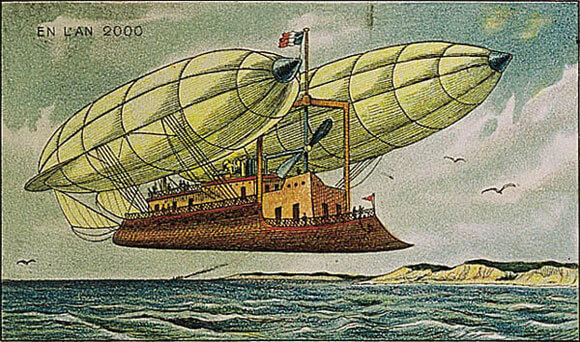
We steampunks love our airships.  Not because they’re particularly efficient or fearsome flying machines, but because they provide the most amusement per pound than any other vehicle.

There is a body of science that describes the performance of airships—much of which is blithely ignored or at least subverted in steampunk stories and artwork. My stories—the Airship Flamel Adventures—feature an airship whose characteristics have at best a tenuous relationship with actual Airship Science. So I know whereof I speak. However, I recently discovered a novel airship technology that seems completely impractical (and being more impractical than a standard airship is quite an accomplishment) yet which contains just enough real science to keep things interesting.

Airship of the future conceived in 1899.

Airships, including hot air balloons, work because they have a large volume filled with a gas that is less dense than air.  The gas weighs less than air, so it wants to float. If you add in the weight of the rest of the airship (such as the gondola and the cells containing the lifting gas) and the ship still floats, then you’re in business!  You’ve got an airship that will fly.  (If not, however, your airship sits obstinately on the ground.)

Continue reading

Charles Darwin Considers Dragons

I am happy to offer the electronic version of my latest book, Mr. Darwin’s Dragon, at 50% off ($1.75) during Smashwords‘ July Summer/Winter promotion until the end of July.

This book is the latest Airship Flamel Adventure featuring Professor Nicodemus Flamel, the main character in this series.

Charles Darwin, one of Britain’s most famous and certainly most controversial scientists has a puzzle. How could it be that cultures all over the world–who had no prior contact with each other–have ancient myths of dragons? Could dragons have once lived alongside ancient man? Could dragons still exist?

Professor Nicodemus Boffin and his newly launched airship Flamel takes up the famous naturalist’s request to search for evidence of modern dragons. The voyage takes Flamel from Britain through the Middle East and over the Himalayas to China. The search is barely begun when Flamel discovers an illicit gold mine run by Cai Yuan, a cruel Chinese warlord, and his corrupt British collaborator. Professor Boffin and his family are taken hostage in the mine which seems to be guarded by a fierce dragon. The crew of Flamel must rescue them, and together discover whether Mr. Darwin’s dragon truly exists.

Enjoy!

Sounds of the Past

Before there were MP3 files, before CDs, before vinyl, there were waxed cylinders upon which were stored the faint tracings that could be replayed as sound.

Thomas Edison patented the first phonograph in 1880, and cylinders maintained their popularity until the 1910s when discs began to outsell them.   The University of California, Santa Barbara has archived and digitized over 10,000 of these cylinders and made them available on the web.

Rummaging through the collection gives a real taste of the turn of the (last) century. Most of the cylinders contain music. If you like marches, this was the time of John Philip Sousa. There are also some recordings of important speeches of the day, including several by Theodore Roosevelt, and a description of his journeys in Antarctica by Ernest Shackleton.

For the steampunk enthusiast, there’s also a recording from 1905 of a song titled, “Come, take a trip in my air-ship.” (And for a modern recording of this song, listen to Unwoman (a Steampunk favorite) sing it.  You can even buy her version on a cylinder, in case vinyl isn’t hip enough for you!)

Personally, I’ve used these recordings to give a bit of ambience as background music in a historic house museum I’m involved with. Most people don’t notice it, but it lends a bit more authenticity to the experience, I find. And I’ve spent a fair amount of time just perusing the archives, listening to the sounds of ghosts from the past.