Admiral Byrd’s Snow Cruiser

The Snow Cruiser and its crew in Antarctica.

The Victorian Era corresponds well with an age of exploration–exploration of the Poles, as well as Africa and the Far East, not to mention the first ascension of many mountain peaks. And of course, it overlaps with the time frame in which much steampunk literature takes place.

Exploration of the Polar Regions started in the 1800s with the search for the Northwest Passage, and continued into the 20th century. The North Pole was overflown on  May 9, 1926 by the American Admiral Richard Byrd in a Fokker Tri-motor plane, although there is some dispute concerning the accuracy and precision of the sextants used and whether the plane could have flown the distance claimed. Nevertheless, a Norwegian expedition commanded by Roald Amundsen reached the pole three days later in the airship Norge cementing the achievement of this goal for good.

Admiral Byrd commanded several Antarctic expeditions over the decades from the 1930s to the 1950s. On his third expedition, Byrd delivered what he hoped would be an innovative vehicle, the Antarctic Snow Cruiser to the Little America base.  The vehicle was designed by Thomas Poulter, a veteran of Byrd’s previous expedition, and was built at the Pullman Company. Its dimensions were huge: 17 meters long and 61 meters wide. During its journey to Boston where it was to be loaded onto the ship to Antarctica, its size caused steering problems, not to mention traffic jams in the cities it passed through.

Cut-away view of the Snow Cruiser showing its capabilities.

The Snow Cruiser was designed to extend the range of exploration from the main base of Little America on the Ross Ice Shelf. The Snow Cruiser had living quarters for a crew of five and included sleeping areas, a galley, a machine shop, and a photographic darkroom. More exciting was the biplane that the Cruiser carried to increase its exploration range even further.

When the Snow Cruiser was unloaded from the Coast Gard Cutter North Star at Little America base, problems became evident. The immense weight of the vehicle was such that the ramp from the ship’s deck collapsed. The ten-foot diameter tires were designed to be treadless to prevent encrustation by snow. However, they provided little traction. The tires also sunk into the snow as much as 1-meter deep. Several modifications were tried to improve driving performance, and it was found that driving in reverse increased traction to some extent. However, the Snow Cruiser’s longest trek was only 148 km, accomplished completely in reverse. The biplane did perform some aerial surveys of the area near the Little America base, but not as much as originally expected.

A skeleton crew over-wintered in the Cruiser performing scientific observations. By the next spring, the US government was more concerned with the growing threat of war, and Antarctic exploration was halted. The Cruiser became buried in the snow and eventually the ice shelf where it stood broke away. While it is not known where exactly the Cruiser ended up, it is certain that it now lies on the seabed.

While the Snow Cruiser did not reach its potential, it is still a great example of innovation being harnessed for science, a feature that has continued from the Victorian Age, all the way up to the Apollo moon missions and Ingenuity, the robotic helicopter that just finished its mission flying around on Mars.

End of the Year Discounts on Smashwords

From December 15 to the end of January 1, the four issues in the Airship Flamel Adventures Series will be discounted on Smashwords for half-price (or $1.74 for the electronic versions of these books.) And the Anteprologue to the first book in the series is available free!

The main character (our hero!) is Professor Nicodemus Boffin, who commands the airship Flamel, an airship which contains all manner of advanced technologies, much invented by the professor himself. The Flamel travels the world on an extended voyage of discovery. At times, however, Flamel and its crew are called upon to undertake “extraordinary duties” for Queen, Country, and Empire.

Click on the titles below to read more about this steampunk adventure series.

Enjoy!

Where Treasures Lie — Now available as an Ebook!

I was pushing so fast to finish the final formatting of the paperback version of my latest book in the Airship Flamel Adventures–Where Treasures Lie–that I put off formatting it for various other ebook formats that are not Kindle (Apple, Barnes and Noble, Kobo, etc). That hole has now been filled! The book is now available on Smashwords.com in many different ebook formats.

Happy Reading!

Steampunk Cuisine, Part 2: Evolutionary Silver Designs

The Steampunk Aesthetic is based largely on the design features of the Victorian Era, when use of decoration was foremost.  However, I like to think of the Steampunk Aesthetic as “fancier than it needs to be to be functional”.

While many Victorian/Steampunk items are fancier than they need to be, this concept is perhaps demonstrated most clearly in the design, decoration, and alleged function of Victorian silver.

In our more utilitarian times, tableware generally consists of a fork, a knife, and a spoon, maybe with a salad fork, soup spoon, or teaspoon added on if the dinner is fancier. And these utensils pretty much take care of all our needs.

However in the later part of the Victorian Era, the co-called Gilded Age, there was an explosion of various tableware and serving pieces each one specialized and required for each course, or sometimes, even each type of food on the plate. And each one was deemed essential for the proper table.

Today we would use a knife and form to serve and eat fish. However, the fish fork was designed to be optimized for the task. The fish fork’s leftmost tine was longer than the rest and sported a notch. These features were meant to simplify removing the fish’s bones and skin. Although I wonder how much easier this task became, and how much one was supposed to merely ogle at the hostess’s fancy silverware.

The variety of forks increased over time to include (beside the modern dinner and salad forks) luncheon forks, dessert forks, pastry forks, oyster forks, berry forks and ice-cream forks. All deemed crucial for using at fancy meals.

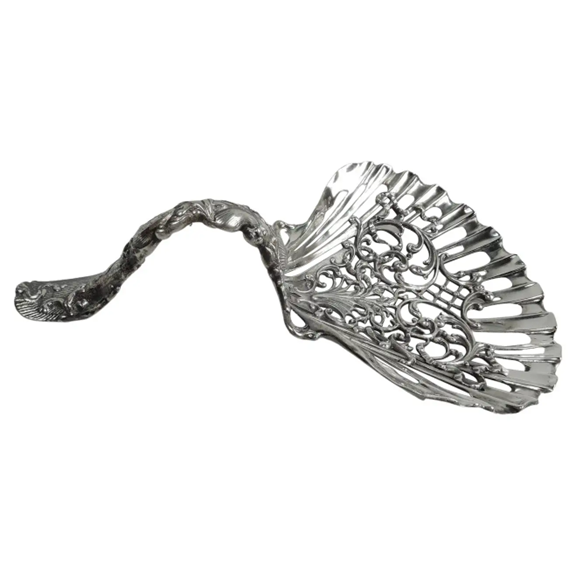
It’s really with the serving pieces that the wide diversity of forms reached its zenith.  Let’s start with the asparagus tongs, below.

I like these because the rectangular design is so unusual in flatware. There are some more usually shaped asparagus tongs, but they all allow serving the exotic asparagus spears without causing a mess.

Asparagus Tongs, Tiffany and Co.

The dangerous-looking utensil shown below is a cucumber server, although it can sometimes also used to serve tomatoes as well. The tines make it look like a spork turned 90 degrees, but I could not find the rationale for the tines. Perhaps they are only to ensure the cucumber slices don’t fall off while serving.

Cucumber Server

The fish server below consists of a wide fork and knife which are used to slice a piece from a larger fish and deliver it to the diner’s plate. The width, I assume, is to prevent the fish from separating while being transferred to the place. I suppose this serves the same function as a spatula would today, just with more style.

Fish Server

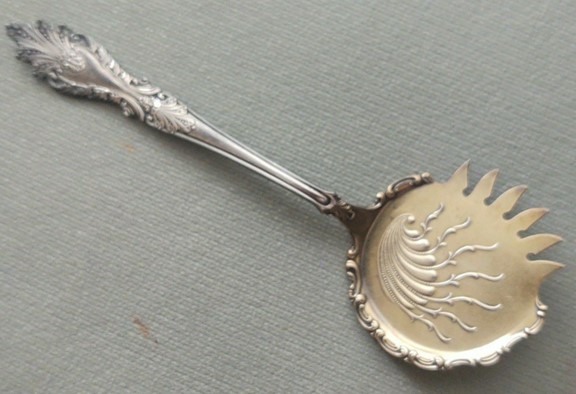
Desserts had their own assortment of specialized tableware. The bonbon scoop (below) seems to have been used to serve chocolate-covered goodies without untoward stickiness. The ice cream server looks more like it’s made for slicing than scooping, although there are period designs that are concave as well. In any case, the design is very different than the ice cream scoop of today.

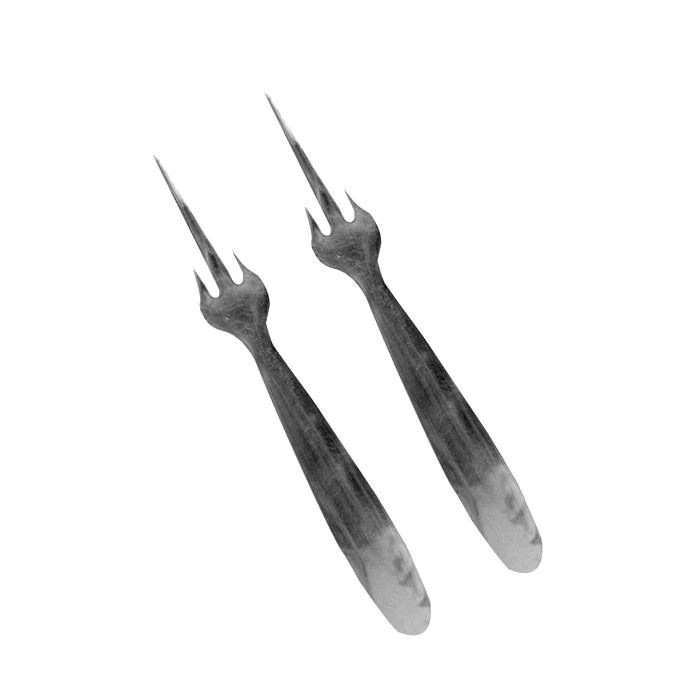
Finally, there is the mango fork. This bizarre three-tined fork is inserted at the end of the mango and while holding the fork, the flesh is cut away. It’s a very elegant way of saying, “I’m not only rich enough to afford exotic tropical fruit, but also the specialized tableware with which to eat it.

Bonbon Scoop
Mango Forks

Obviously, very few working-class or even middle-class homes would have been equipped with any of these fancy utensils. Not when a knife, fork, and spoon will do the work just fine. Their main function was as a display of conspicuous consumption–to demonstrate that you are rich enough to possess the latest and most stylish tableware to impress your equally gilded friends.

So, although fancy silverware may satisfy the Steampunk “fancier than it needs to be to be functional”, I think iit exaggerates its functionality when one of its main functions is to impress.

“Dreams Beyond Gold”– A new FREE short story from Michael Tierney

Captain Jack Fawkes is a feared airpirate captain. Even though he has gained much renown and bounteous treasure from raiding airships, he is beginning to feel somewhat tired of the marauding life, and looking to try his hand at more literary pursuits. How will he manage to escape his airship without his crew realizing that he is giving up his former life—and the treasures he earns for them? It’s a tale of swashbuckling adventure along with a bit of humour.

“Dreams Beyond Gold” is available HERE. You will also be signed up to receive my periodic newsletter with information on my writing, as well as other interesting tidings. And I pledge: No Spam.

Welcome aboard!

Vacuum Airships: Reality or Steampunk Fantasy?

We steampunks love our airships.  Not because they’re particularly efficient or fearsome flying machines, but because they provide the most amusement per pound than any other vehicle.

There is a body of science that describes the performance of airships—much of which is blithely ignored or at least subverted in steampunk stories and artwork. My stories—the Airship Flamel Adventures—feature an airship whose characteristics have at best a tenuous relationship with actual Airship Science. So I know whereof I speak. However, I recently discovered a novel airship technology that seems completely impractical (and being more impractical than a standard airship is quite an accomplishment) yet which contains just enough real science to keep things interesting.

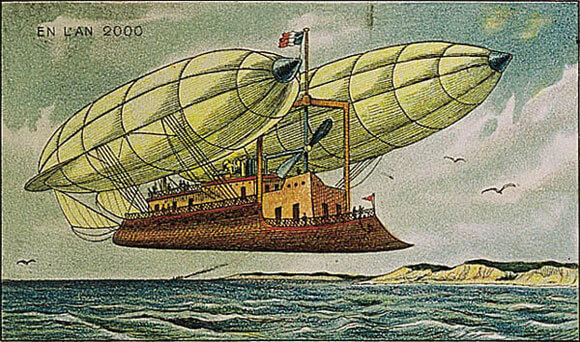
Airship of the future conceived in 1899.

Airships, including hot air balloons, work because they have a large volume filled with a gas that is less dense than air.  The gas weighs less than air, so it wants to float. If you add in the weight of the rest of the airship (such as the gondola and the cells containing the lifting gas) and the ship still floats, then you’re in business!  You’ve got an airship that will fly.  (If not, however, your airship sits obstinately on the ground.)

Continue reading

Pirate Epicureans

When considering pirates (or airpirates, if you’re in a steampunky mood), one’s thoughts immediately turn to treasure–large chests of coins, gold bars, and bejeweled bric-a-brac. And I’m sure no self-respecting pirate would pass these by. In reality, however, the definition of “treasure” was broader than what we normally assume.

I give you two examples of pirates who changed western cuisine as we know it.

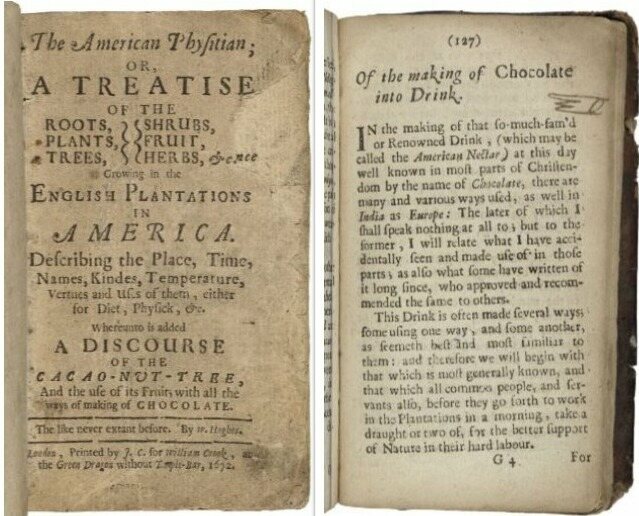
Hughes’s treatise includes instructions on how to convert cacao to the chocolate drink.

William Hughes was a botanist by training, or at least by avocation. Hughes set out for the Caribbean in the 1630s and eventually found his way onto the crew of a British privateer, sanctioned by the Crown to raid Spanish trading ships. As they made their way around the Caribbean in search of plunder, Hughes had the chance to survey the local flora, how it could be grown, and how the indigenous population prepared and ate it. In 1672, after his piratical days were over, he summarized his findings in a treatise titled The American Physitian. Among the plants he described were the lime (“excellent good against the Scurvie”), sugarcane (“both pleasant and profitable”), and prickly pear (“if you suck large quantities of it, it coloureth the urine of a purple color” which I can only imagine was the basis of many shipboard pranks.)

The largest section of his book concerned cacao which he was so enamored with that he deemed it “the American nectar”. The Spanish had already encountered cacao as early as Columbus in 1502, but it took them over a century to accept it as suitable for drinking. One traveler to Nicaragua held it to be more fit for pigs than people. The British were lagging even further; it wasn’t until Hughes’s book that cacao was fully described in English. The ingredients that Hughes describes to flavor hot chocolate reads like a description of the spice trade itself: “milk, water, grated bread, sugar, maiz, egg, wheat flour, cassava, chili pepper, nutmeg, clove, cinnamon, musk, ambergris, cardamom, orange flower water, citrus peel, citrus and spice oils, achiote, vanilla, fennel, annis, black pepper, ground almonds, almond oil, rum, brandy, sack.” His personal recipe for hot chocolate has been replicated, and sounds delicious!

By the time his book was published, Hughes had settled down, and was working as a botanist in England, puttering around on the country estate of Viscountess Conway. Cacao, and its liquid version, chocolate, however, expanded out from Central America to the entire globe, surpassing even the spreads of other New World crops as tomatoes, corn, or potatoes.

A generation or so later, another English buccaneer, William Dampier, took up the mantle of Pirate-Epicurean. Dampier had a long history as a pirate and privateer, making three complete circumnavigations of the globe and attacking Spanish ships wherever they could be found. He also seems to have eaten his way around the world, finding new and different foods wherever he went. He recorded his findings in detailed diaries which he kept safe in wax-sealed bamboo tubes. After his first circumnavigation (on which in 1688 he was also the first Englishman to land in Australia), he published his diary A New Voyage Around the World in 1697 to great success. In his book he described a wide variety of animals and their edibility–flamingos, Galapagos penguins, manatees. He highlighted the breadfruit from Tahiti as an excellent food, so much so that the British adopted it to feed slaves in their Caribbean plantations (leading indirectly and much later to the mutiny on the Bounty).

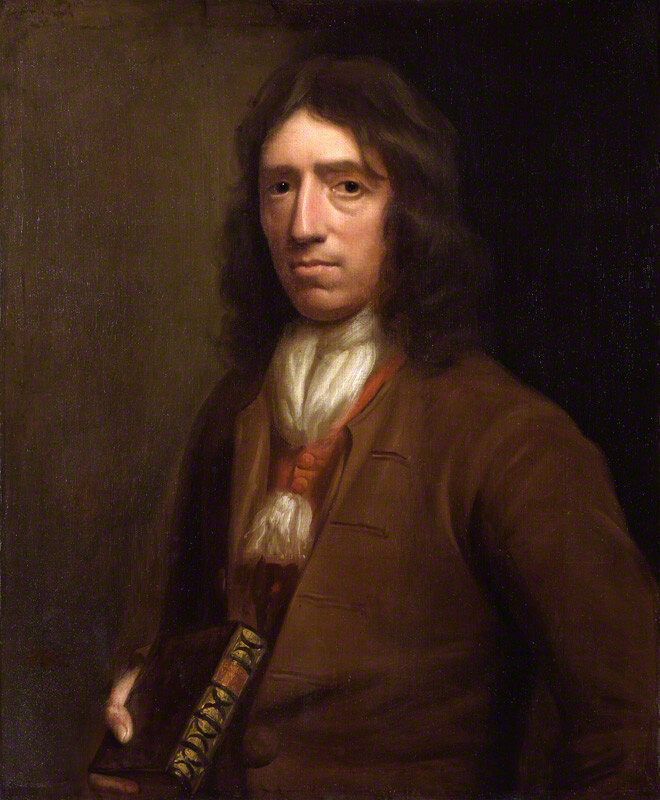
William Dampier, National Portrait Gallery, Public Domain

Dampier also described a fruit “as big as a large lemon … [with] skin [like] black bark, and pretty smooth”–the avocado–and adds that it can be prepared “mixed with sugar and lime juice and beaten together [on] a plate.” Thus, the first recipe in English for guacamole.

His botanical and scientific observations made him famous. Besides compiling lists of edibles, he also monitored the weather, measured currents, and collected botanical specimens throughout his voyages. Both Charles Darwin and Captain Cook carried his book on their voyages. However, he never totally gave up his piratical activities throughout all of his voyages, raiding Spanish ships and ports around the world.

Not a bad side gig for an author.