Colorful Death

I ran across this graphic which describes the origins (and typical toxicity) of many materials that have been used across the centuries as dyes and pigments.  (What’s the difference between a dye and a pigment, you say?  Simply put, a dye imparts color to a substrate (cloth, hair, etc.) while a pigment consists of particles which are mixed into a carrier and coated onto a substrate (think paint.))

In any case, it’s an interesting stroll through arsenic-laced wallpaper, heavy metals, and ground-up mummies, leading to purple mauveine, the first synthetic dye, whose discovery by Joseph Perkin in 1856 started organic chemical synthesis–which itself leads to the modern pharmaceutical and chemical industries.

I hadn’t heard of the web comic before–Veritable Hokum–but it describes itself as “a comic about mostly history, maybe science, and possibly some other stuff too.”–so right up my alley.  I foresee binge reading of its archives in my near future.
The Harrison Clocks

A recent post on the Two Nerdy History Girls blog prompted me to remember the wonderful book “Longitude” by Dava Sobel chronicling the history of John Harrison and his lifelong pursuit to develop an accurate chronometer.

In 1714, the Royal Navy had a problem.  Although it was a rather simple procedure to determine the latitude of a ship at sea (by sighting angle of the the sun at noon or Polaris, the North Star, at night), it was exceedingly difficult to determine a ship’s longitude.  After several maritime disasters resulting from faulty navigation, Parliament passed the Longitude Act which offered monetary rewards for methods to determine longitude at sea.

Continue reading

Fascinating Early Motion Pictures of London

The link below is to an amazing video from Yestervid.com of early motion pictures of London, including the oldest (a view of Trafalgar Square) as well as the earliest recording, on Edison wax cylinder, of the chimes of the Clock Tower.

As interesting as it is to see how much has changed in London over the 100-plus years since most of these motion pictures were taken, it is equally interesting to see how much has not changed.

Also great reference for period costumes!

Yestervid.

A Japanese View of Victorian London

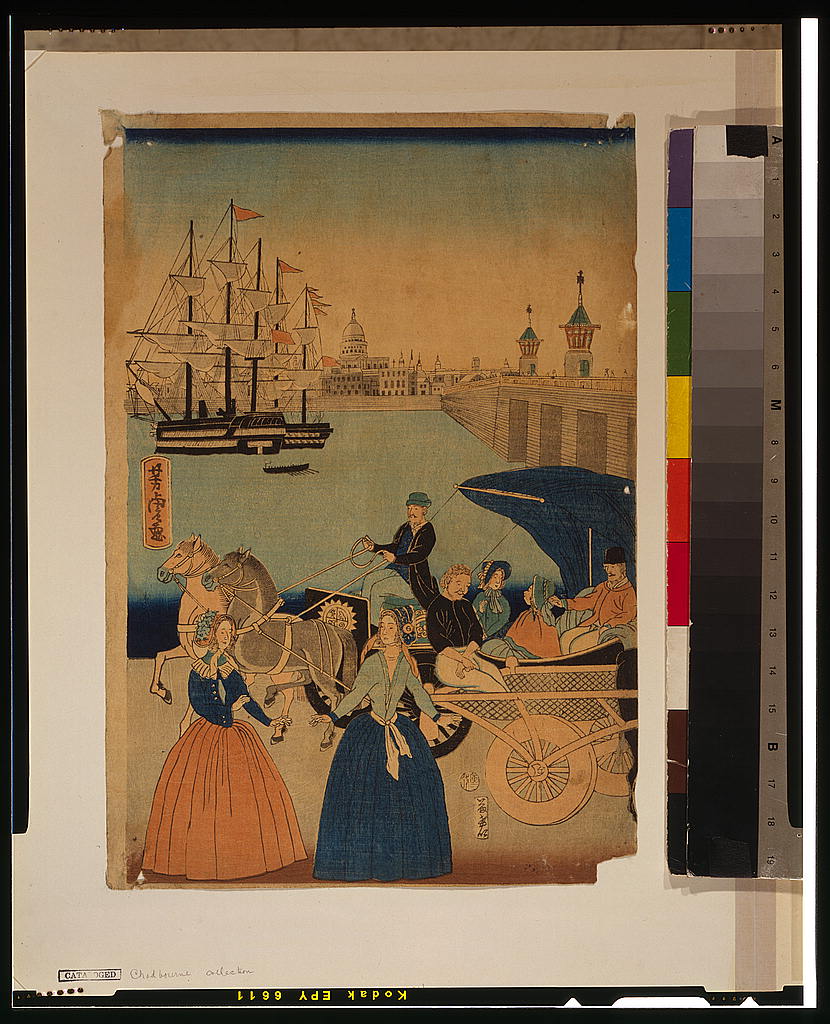
A View of the Thames by Utagawa Yoshitora, c. 1860s.  Image from the Library of Congress collection.

A View of the Thames by Utagawa Yoshitora, c. 1860s. Image from the Library of Congress collection.

In the spirit of Steampunk Hands Around the World 2015, I’d like to share a view of Victorian London as depicted by a Japanese artist of the time, Utagawa Yoshitora. Whether writing, creating, or defining your steampunk persona, it is always helpful to see through others’ eyes and gain a fresh perspective.

More details on the artist and these prints at the always informative Two Nerdy History Girls blog.

The Great Blizzard of 1888

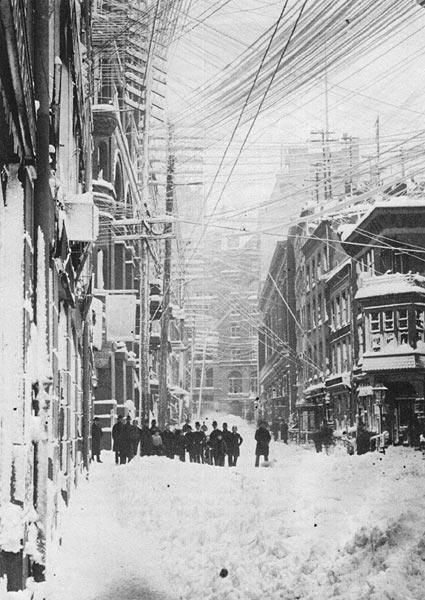
The weight of the snow snapped telegraph and telephone wires in New York City, hindering communications

The weight of the snow snapped telegraph and telephone wires in New York City, hindering communications

As the east coast of the US prepares for a significant snowstorm–Snowmaggedon, Snowpocalypse, etc.–here’s an article about the grandfather of all US blizzards, the Great Blizzard of 1888.  The article focuses on the storm’s effect on New York City, which was horrendous in today’s terms, but the storm also affected the entire northeast of the US.  Remember this was in the days of no weather forecasts–so the storm arrived without notice–and no snow plows–so its effects lingered for weeks after the storm cleared.

Coincidentally, two months before this blizzard, there was another Blizzard of 1888 that affected the center portion of the US.  This storm is also sometimes called the Schoolhouse Blizzard or the Children’s Blizzard because it came on so quickly and unexpectedly that many children were trapped in their schoolhouses until they could be eventually rescued.

Airships over California!

If you tracked the frequency of Google searches, you’d find a large spike last week for “Bay Area airship”, but not because of a sudden invasion of dirigibles over the San Francisco Bay.

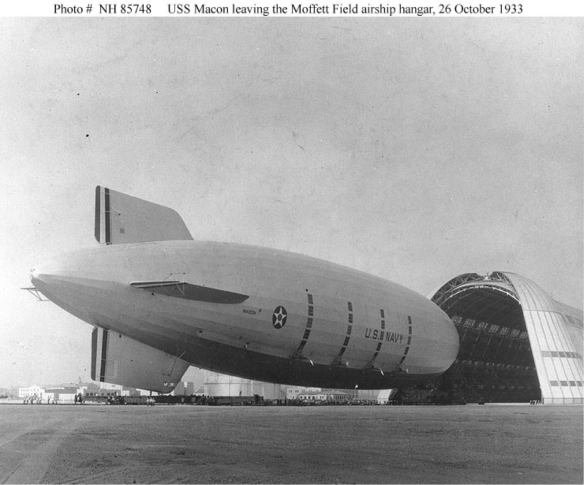
The Germans were the acknowledged leaders in airship technology during World War I. But they lost the war anyways and as part of war reparations, Luftschiffbau Zeppelin built an airship for the US–USS Los Angeles (ZR-3).  After the successful tests of this airship, the US Navy commissioned two airships from the Goodyear Zeppelin Company. The two airships were christened the USS Akron (ZRS-4) and the USS Macon (ZRS-5).  The ships were huge, only slightly shorter than the Hindenburg.

USS Macon entering Hangar One

The Akron was assigned to Lakehurst, New Jersey. She had an accident-plagued career that lasted less than two years which ended with its crash into the ocean off the New Jersey coast with the loss of all but three of her crew. Continue reading